The Long-Term Potential of AI SDR Agents
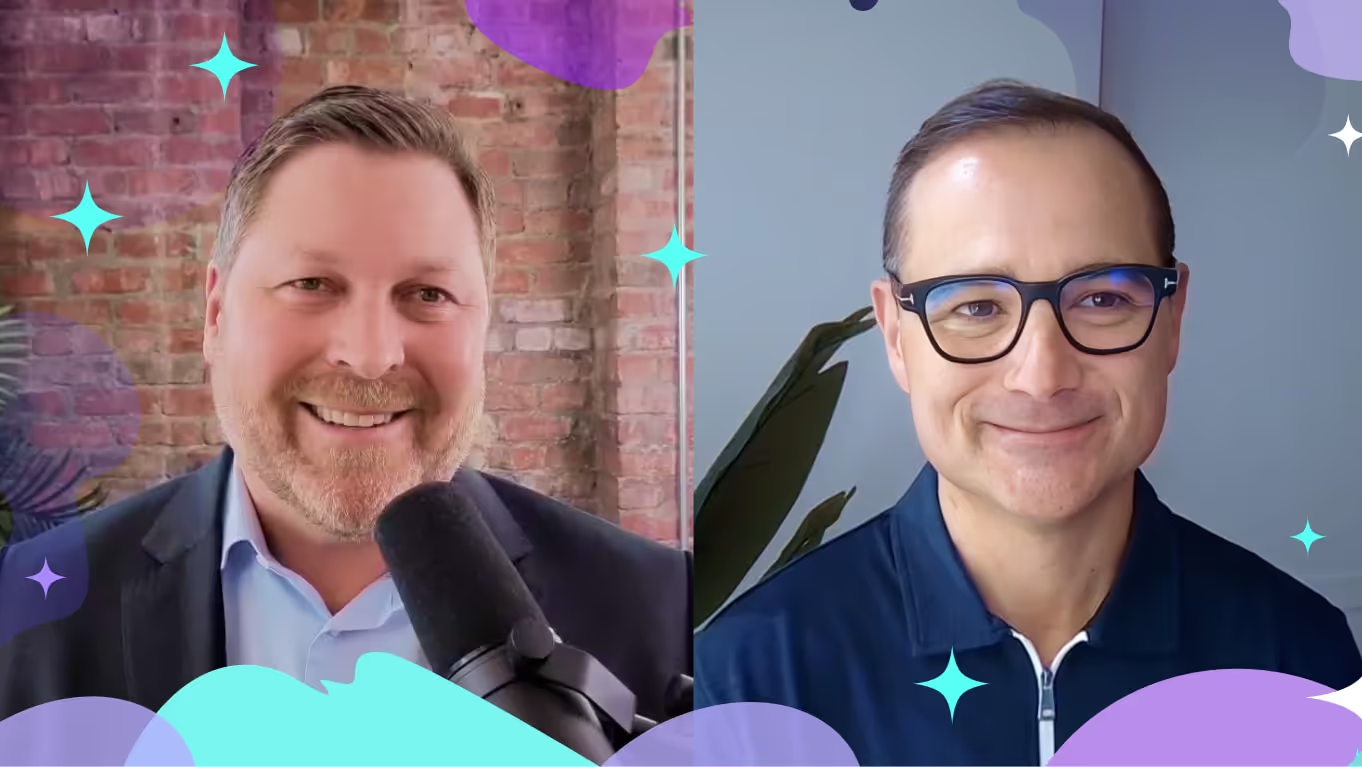
Hear from Alex Bard, Managing Director at Redpoint, and Scott Beechuk, Partner at Norwest, on why AI SDRs are attracting major funding, and where they see the category heading over the next 3–5 years.


Hear from Alex Bard, Managing Director at Redpoint, and Scott Beechuk, Partner at Norwest, on why AI SDRs are attracting major funding, and where they see the category heading over the next 3–5 years.

TRANSCRIPT
Robert Zimmerman – Qualified
Hey. Good morning, everyone. I’m thrilled to be here this morning with Scott Bichik, one of our partners from Norwest, and Alex Bard, managing director from Redpoint.
And we are going to have an amazing session this morning.
Let’s start with Scott. Zooming out a little, before we get specifically into the topic at hand of AI SDRs, can you set the stage, about what we’re going through, the uncertainty we’re facing as a market right now? What is your take on how AI technology can help organizations navigate these economic uncertainties?
Scott Beechuk – Norwest
Oh, first of all, thanks for thanks for having us both, Robert. It’s awesome to be here, and excited to, have this conversation with you. And, boy, what a time. Right?
Jumping right in here, this this year has been, you know, a very dynamic year. A lot of ups and downs, a lot of twists and turns. And I think for companies, you know, as they think about how to navigate the waters of all the volatility that we’ve been seeing this year and all the, you know, economic challenges that we’ve been up against, I think most companies that I talk to are thinking about, you know, how they continue to turn the turn the knobs on becoming more efficient, how they do more with less. You know, a lot of the themes that we saw building up over the last couple years, particularly with AI, are being accelerated now just due to, the uncertainty right now in the markets.
And I think the good news is there’s a lot of very healthy companies out there. Companies that have built some real momentum, some real, you know, they’ve been they’ve been filling their pipelines over the last several quarters. It’s been a it’s been a really good run. And now they’re asking the question, how do we keep up that energy?
How do we keep up that momentum?
And, you know, they’re also setting themselves up for, I think, a future where human work is gonna continue to be automated. I know we’re gonna talk a lot about that today. But, you know, now the thought the thought process is more of less about, okay. Well, how can I add AI as an ingredient? Now how can I use AI as a fundamental platform for building the future of my business?
Robert Zimmerman – Qualified
You know, you bring up a a really interesting point, which, you know, given the these uncertainties that we’re experiencing, I’ve I’ve been very excited about the potential that we can really generate out of this. I’ve always been a big believer that coming out of situations like these, there are new dynamics that present themselves and potentially opportunities.
Alex, do you feel the same way about that? Do you, looking at sort of everything we’re experiencing, what is about the promise of AISDR as agents that excites you most given these sort of in this environment we’re in?
Alex Bard – Redpoint
Yeah. I mean, again, Robert, thank you so much for having, Scott and I. We really enjoy these conversations with you all. I I I the thing I would say is, you know, you first of all, in terms of what’s happening in the environment Scott touched upon this, there’s obviously a bit of turbulence right now.
A lot of it is around sort of the trade wars and and tariffs, and and markets don’t like uncertainty. And and, clearly, we’re still figuring it all out on on kind of a global scale. The the advice for companies is just to operate through it and and focus on the business. I think the companies that will be able to sort of navigate through any sort of turbulence will be the ones that are still growth companies.
You you still see in public and private markets the highest multiples, the highest value being paid to companies that are growth companies. So that is kind of like the headline. It is still very important to grow. Now where you’re getting the ultra premiums are where you’re a growth company, but you’re doing it efficiently.
You remember in the sort of the COVID era, you had growth at all costs. It didn’t matter the cost of getting to that sort of growth today. Again, public and private growth, but efficient growth is where the all the premiums are. Now how do you get to efficient growth?
Well, the companies that are getting to efficient growth are the ones who are doing the best job of leveraging AI inside of the firewall to be able to do the job that they had done previously with people now to do that more with technology. And I sort of step back out of all of that, and I think about just the major technological shifts over the years and the opportunities that those, you know, shifts create. And and we all know all of us were at, you know, salesforce dot com together. Benny off and and the rest of the team did such a great job of taking advantage of the move to cloud.
And that was, like, the technological shift going from on prem to cloud and the business model that supported it going from perpetual licensing to SaaS and monthly pricing that created this, like, massive dislocation and opportunity for lots of amazing companies to be built. Not since then have we seen the same thing happening where it’s both a technological and business model shift, shift, and that is with AI. And AI is, I think, going to be even more disrupted than the move to cloud was. And I mean that both in terms of the technology itself and what it enables you to do, but also the business model that’s sort of underpinning it more around work than necessarily in enabling technology. And so I it is regardless of what’s happening in the market, some incredibly exciting time for the companies that are forward leaning into this, into this shift.
Robert Zimmerman – Qualified
Scott, do you, have any anything you’re sort of would add to that? And if you put yourself in a customer’s shoes, for example, we’ve been talking about the companies that are selling these technologies. But as you think about, as a customer and companies may be looking to tighten budgets and think a little bit differently, what would you say about companies thinking about potentially embracing AI agents to supplement headcount or other areas where they might see benefits?
Scott Beechuk – Norwest
Yeah. You know, I think, Alex touched on an important point, which is that we are experiencing a dramatic shift. It’s almost like we’re turning a a massive chapter in the book of this entire journey that we’re on since the beginning of the Internet.
Companies there are, you know, I hear companies think a lot about AI as an enabler, as a as a way to, you know, help them, be more productive or maybe they can, you know, augment their human workers and become more efficient. Then there’s other companies that view this in a totally different way. They view this this chapter as being the next ten to twenty years of where the entire world is going, not just the technology world. I mean, bear in mind that AI is gonna benefit technology companies, but it’s gonna benefit non tech companies as well.
We’re gonna we see CPG and manufacturing getting, you know, completely revolutionized in how they think about, running their businesses and being productive, as we look for the future. And so I think that mental mind shift is something that we’re seeing in twenty twenty five. It’s it’s it’s really exciting because now more than just, you know, thinking about how do we, you know, maybe we we we adopt a little bit of AI and some app that we currently use. Companies are starting to say, okay.
How can we how what is what are the next ten years of our business really gonna look like?
We’re starting to see AI agents now, for example, that are doing more than what we’ve experienced initially with ChatGPT. We’re starting to see AI agents do deeper level reasoning. And if you can imagine AI continuing down that road, which it will, it will continue to think more, creatively. It’ll think more complex.
It’ll it’ll be more sequential. It’ll be multistep. It’ll in a way, it just becomes more human. And as you start to think about how that affects our ability to sell, it’s going to not only help our lowest order, sellers and agents, but it’s going to help everyone in up the entire sales stack all the way to the CRO in the company.
And I think that’s that’s part of why, you know, companies that that that are fully embracing the ten to twenty year vision are not looking at this as let’s just simply help the our SDRs. But they’re thinking about their AEs. They’re thinking about their managers. They’re thinking about the entire chain all the way to the CEO.
And I think those the the, you know, the companies that are leaning into this the most, all of this new thinking is actually coming from the CEO right on down.
Alex Bard – Redpoint
Yeah. Robert, I’ll I’ll maybe add to something Scott said that I think is exciting. Like, by by virtue of the position that Scott and I are in, being in venture capital, it’s an amazing time. We get to see, like, some of the latest and greatest innovations, and we get to see across different markets, and we get to see it in different stages.
Right? And so we’re seeing already today AI in customer service and support augmenting humans in certain cases when it’s more of a level two or level three type support, replacing humans altogether when it’s level one and sort of more generally repetitive.
We’re seeing AI applied in the engineering, sort of discipline where AI is now this great copilot, but it’s increasingly, with companies like Cursor and others, doing more of the actual writing of code. There was a a tweet published from Y Combinator, which is one of the largest sort of incubators of of tech companies that twenty five percent of the most recent graduating class had ninety five percent of their code written by AI.
Just think about that. Right? Now it’s it’s the written code is more of like a junior developer, and over time, it’ll start to move up the the stack. And then now we’re starting to also see it in the go to market stack.
And so you can imagine all these various disciplines AI sort of coming in and getting better and better and better. The other thing that that I think is pretty amazing, and Scott touched upon this, is as we’re moving up the sort of the rungs of AI capability, more and more real value is unlocked from originally when it was chat GPT three five to now you can see it with four o and and sort of later what what you’re able to do. But now it won’t be kind of a one off. Like, you ask it a question, it gives you an answer.
It’ll be more you give it a task, and it goes off and actually does that task. And I think as you think about that across engineering, you think about that across go to market, you think about that in finance, you think about that in every aspect of your business, there’s gonna be some really incredible unlocks. And the companies that, as I mentioned earlier, I think that are thinking that way and they’re at the forefront of it and and they’re thinking about it ten to twenty years out are really gonna be able to take advantage of what I think is a once in a lifetime opportunity.
Robert Zimmerman – Qualified
I love that, especially as you’re leaning into this. Obviously, the two of you sit on a lot of different boards, of companies out there today. Give me, your perspective. If if you were in the shoes of the CMO and you were coming to the board to present your vision over the next year, what would you expect to hear from somebody who you feel is leaning into this?
What would you wanna hear from them?
Scott Beechuk – Norwest
Yeah. Yeah. You know, I I couldn’t agree with, Alex more. This is probably the most exciting time, that we’ve ever experienced in technology.
You know, I I was talking to, a CMO the other day who is going through a wholesale rethinking of the entire stack. A lot of CMOs have, you know, twenty or thirty different SaaS applications today, and that’s not uncommon. In fact, I’ve seen some companies with with more. And it’s not also not uncommon to sort of cycle through those applications on a regular basis and try new things.
But, you know, if you’re looking backwards, if you look in the rear view mirror, what you see is a lot of passive software systems that CMOs could try, you know, throw things against the wall, see what sticks. You know? Maybe, try a new algorithm here, a new algorithm there. You know?
Maybe we can, you know, pick up a a couple more, points of conversion along the way.
But this conversation, I I’d love to name the company, but it’s it’s it’s a it’s a a portfolio company. And the the conversation took a totally different turn, which for me was super exciting.
It was, okay, let’s actually picture what is the future of the world look like when AI is powering everything that touches the customer.
From the moment that that customer gets even has an interaction with our brand anonymously all the way through the entire funnel into the point where we are engaged with that customer and we continue to support them.
So this is where marketing and sales start to, you know, kinda have a a blurry line, which for me gets very exciting because AI doesn’t think in terms of marketing or sales. AI does exactly what we what we tell it to do.
And great AI systems will reason their way through. Okay.
How can we help connect and create more meaningful connections and relationships at every step of the customer journey?
And that was the thought process in that CMO’s mind. It was, how do we unlock more meaningful human connections at every step from the anonymous first touch to, you know, deep into the sales funnel?
And how do we automate all that to a point where there’s less overhead, less noise, less spam, and just real deep human connection and make better use of everyone’s time.
And that’s a pretty exciting way to think about the future with AI.
Alex Bard – Redpoint
Yeah. I’ll add, just to to what Scott said, which is, you know, software historically has been about, you know, some incremental improvement to what a human does. Right?
Most applications have been, quote, applications create, read, update, you know, kind of delete. And the better we got, the more efficient it made sort of us at at at doing those things.
I think this is the time not to think about incrementalism.
This is the time to, like, kind of burn the boats and rethink it all together. Right? Start from zero.
Don’t think about I’ve got this stack of tools, and how do I make each one of them slightly better?
How do I plug in one tool to kinda replace this this weird Jenga of stuff that I’ve sort of accumulated over the last n number of years?
This is like a moment to burn it all down and kinda rebuild it with a with a totally new mindset, which is super exciting.
I mean, if if you recall when when Scott and I, first invested in in Qualified, it was not an AI SDR company.
The founding sort of principle of the company was marketing automation as it had existed is broken.
It’s too complex. It’s too brittle. It’s got too many workflows. This is all about sort of human engagement.
Let’s think about how do you simplify and improve that sort of human engagement around progressing somebody through the the purchasing experience.
That same principle holds true today. Qualified have just done an incredible job of understanding and seeing AI as a catalyst to all the things that we’ve built to do that even better.
And where I think we are sort of on our journey today, we we kinda talk about AI SDR and and kinda why everybody’s excited about it.
That’s just the beginning.
Really, this is about completely rethinking the entire GTM stack as Scott said.
It’s not this this thing sales is here and marketing is here and, you know, kind of performance is here and brand is here.
It’s all now one thing, and I think Qualified has an incredible sort of entry wedge into that.
But our opportunity is to rewrite a GTM stack on the foundation and principles of all the data that we have, the signals that we have, and leveraging AI to be able to create that amazing end to end journey for customer.
Robert Zimmerman – Qualified
I love that. In fact, it sort of dovetails with a lot of what I’ve been reading and hearing.
You know, the analyst reports talk about the continued investment in software technology, especially in b two b.
As you think about the next few years, where do you believe the lion’s share of that technology investment is gonna go?
How do you think this plays out if you were to project over the next two, three, four years?
And maybe, Alex, start with you.
Alex Bard – Redpoint
Yeah. Look. I mean, I yeah. I think we’ve we’ve we’ve been talking about this.
If I’m the CEO, and I think Scott is absolutely right, this can come bottoms up with kind of, like, individual, you know, drivers rather than passengers inside of the company.
I, you know, I I sort of really appreciate this book written by Frank Slootman, who’s one of the best CEOs in the valley of the CEO of ServiceNow.
And then Snowflake, he wrote this book called amp it up.
And then amp it up sort of one of the central points is as an employee inside of a company, are you a driver or a passenger?
So drivers inside of companies will be ones that embrace AI sort of early, play with it, use it, and infect the company, you know, sort of bottoms up.
But I also think that for real transformational change, it has to come top down. It has to come from the executives. It has to come from the CEO.
So when you think about investment, if I were the CEO of any company at any scale, a massive company today down to a small company, I would be pushing across the entire organization this thinking of how do we become better, smarter, faster, more efficient leveraging AI.
And if you don’t have an AI story inside of your department and if it’s, like, universal across the company, I think you’re really going to get lapped by somebody very, very quickly.
And so when I think about that investment, I think that it’s is across every part of the organization.
We talked about it. We see it below hanging fruit in customer service.
There’s a lot of repairability and sort of, you know, people aren’t happy in their role, and they and there’s a lot of charm.
And so, like, we see it there. We now see it in engineering. We’re go we’re seeing it in the GTM side.
I’m seeing it a lot in finance. We’re seeing it in legal.
Literally, I mean, you’re you’re hearing us kind of talk about every aspect of the business, but I think that that’s absolutely right.
Scott Beechuk – Norwest
Yeah. Couldn’t agree more, with that, Alex.
I think the the there’s also another thing that great companies are I I keep hearing repeatedly, and that is, you know, there’s nothing to be afraid of here.
Across the employee base at every level, AI is going to, a, it’s gonna supercharge every role in a company. Okay?
It’s gonna automate some of the work, but new roles and new opportunities to be more human and do more interesting work are already being created and will continue to be created at an accelerating rate.
And so, you know, you work your way up from the from the SDR and you start to think, well, you know, Qualified, and Piper are the SDR’s best friend.
Why? Because they work alongside your SDRs and they help move things quicker through into into the sales funnel.
It helps us become more helps customers become, understand their customers better, helps them fill the pipeline more, creates more qualified opportunities, etcetera, etcetera.
And then you start to think about what happens over time.
Well, an AE is spends a lot of his or her time, doing a lot of manual data entry.
I mean, nobody likes entering information into your CRM. Nobody that I know of.
And and so what does AI help us do?
Well, it certainly could eliminate most data entry as we go in into that process.
But what about all the other overhead that exists and all of the sort of the the the waste that we have as humans doing our jobs throughout the entire go to market, organization.
Well, I’m a sales manager, for example. And I know I’m getting way outside the scope of the AISDR and pipe for today, but I’m thinking you asked for the next, you know, two to three years.
I start to think about how does AI help the sales manager do a better job of predicting, doing forecast calls, reporting up through the the management chain to this DMO and to the CRO and to the CEO and the CFO.
How do we how does AI help everyone in the entire organization do their jobs more efficiently so that we can do the thing that we’re most qualified to do as human beings, which is build more human connections?
And building deeper trusted relationships with other human beings helps well, it makes everybody’s life better, and it also helps us sell more.
So I think that’s where we’re going.
Robert Zimmerman – Qualified
Do you see what Scott did there? He said, what are we more qualified to do? I picked up on that. Well done.
That that was well done. And, actually, I couldn’t think of a better way to, to put a bow on this session.
Scott, Alex, it’s always a pleasure. Thank you so much for being on this journey with us, and really excited to see what is gonna be happening over the next, number of months, but also number of years.
So with that, thank you both.
Scott Beechuk – Norwest
Thank you. Much.
Alex Bard – Redpoint
Thank you very much.

Stay up to date with weekly drops of fresh B2B marketing and sales content.
Hear from Alex Bard, Managing Director at Redpoint, and Scott Beechuk, Partner at Norwest, on why AI SDRs are attracting major funding, and where they see the category heading over the next 3–5 years.


TRANSCRIPT
Robert Zimmerman – Qualified
Hey. Good morning, everyone. I’m thrilled to be here this morning with Scott Bichik, one of our partners from Norwest, and Alex Bard, managing director from Redpoint.
And we are going to have an amazing session this morning.
Let’s start with Scott. Zooming out a little, before we get specifically into the topic at hand of AI SDRs, can you set the stage, about what we’re going through, the uncertainty we’re facing as a market right now? What is your take on how AI technology can help organizations navigate these economic uncertainties?
Scott Beechuk – Norwest
Oh, first of all, thanks for thanks for having us both, Robert. It’s awesome to be here, and excited to, have this conversation with you. And, boy, what a time. Right?
Jumping right in here, this this year has been, you know, a very dynamic year. A lot of ups and downs, a lot of twists and turns. And I think for companies, you know, as they think about how to navigate the waters of all the volatility that we’ve been seeing this year and all the, you know, economic challenges that we’ve been up against, I think most companies that I talk to are thinking about, you know, how they continue to turn the turn the knobs on becoming more efficient, how they do more with less. You know, a lot of the themes that we saw building up over the last couple years, particularly with AI, are being accelerated now just due to, the uncertainty right now in the markets.
And I think the good news is there’s a lot of very healthy companies out there. Companies that have built some real momentum, some real, you know, they’ve been they’ve been filling their pipelines over the last several quarters. It’s been a it’s been a really good run. And now they’re asking the question, how do we keep up that energy?
How do we keep up that momentum?
And, you know, they’re also setting themselves up for, I think, a future where human work is gonna continue to be automated. I know we’re gonna talk a lot about that today. But, you know, now the thought the thought process is more of less about, okay. Well, how can I add AI as an ingredient? Now how can I use AI as a fundamental platform for building the future of my business?
Robert Zimmerman – Qualified
You know, you bring up a a really interesting point, which, you know, given the these uncertainties that we’re experiencing, I’ve I’ve been very excited about the potential that we can really generate out of this. I’ve always been a big believer that coming out of situations like these, there are new dynamics that present themselves and potentially opportunities.
Alex, do you feel the same way about that? Do you, looking at sort of everything we’re experiencing, what is about the promise of AISDR as agents that excites you most given these sort of in this environment we’re in?
Alex Bard – Redpoint
Yeah. I mean, again, Robert, thank you so much for having, Scott and I. We really enjoy these conversations with you all. I I I the thing I would say is, you know, you first of all, in terms of what’s happening in the environment Scott touched upon this, there’s obviously a bit of turbulence right now.
A lot of it is around sort of the trade wars and and tariffs, and and markets don’t like uncertainty. And and, clearly, we’re still figuring it all out on on kind of a global scale. The the advice for companies is just to operate through it and and focus on the business. I think the companies that will be able to sort of navigate through any sort of turbulence will be the ones that are still growth companies.
You you still see in public and private markets the highest multiples, the highest value being paid to companies that are growth companies. So that is kind of like the headline. It is still very important to grow. Now where you’re getting the ultra premiums are where you’re a growth company, but you’re doing it efficiently.
You remember in the sort of the COVID era, you had growth at all costs. It didn’t matter the cost of getting to that sort of growth today. Again, public and private growth, but efficient growth is where the all the premiums are. Now how do you get to efficient growth?
Well, the companies that are getting to efficient growth are the ones who are doing the best job of leveraging AI inside of the firewall to be able to do the job that they had done previously with people now to do that more with technology. And I sort of step back out of all of that, and I think about just the major technological shifts over the years and the opportunities that those, you know, shifts create. And and we all know all of us were at, you know, salesforce dot com together. Benny off and and the rest of the team did such a great job of taking advantage of the move to cloud.
And that was, like, the technological shift going from on prem to cloud and the business model that supported it going from perpetual licensing to SaaS and monthly pricing that created this, like, massive dislocation and opportunity for lots of amazing companies to be built. Not since then have we seen the same thing happening where it’s both a technological and business model shift, shift, and that is with AI. And AI is, I think, going to be even more disrupted than the move to cloud was. And I mean that both in terms of the technology itself and what it enables you to do, but also the business model that’s sort of underpinning it more around work than necessarily in enabling technology. And so I it is regardless of what’s happening in the market, some incredibly exciting time for the companies that are forward leaning into this, into this shift.
Robert Zimmerman – Qualified
Scott, do you, have any anything you’re sort of would add to that? And if you put yourself in a customer’s shoes, for example, we’ve been talking about the companies that are selling these technologies. But as you think about, as a customer and companies may be looking to tighten budgets and think a little bit differently, what would you say about companies thinking about potentially embracing AI agents to supplement headcount or other areas where they might see benefits?
Scott Beechuk – Norwest
Yeah. You know, I think, Alex touched on an important point, which is that we are experiencing a dramatic shift. It’s almost like we’re turning a a massive chapter in the book of this entire journey that we’re on since the beginning of the Internet.
Companies there are, you know, I hear companies think a lot about AI as an enabler, as a as a way to, you know, help them, be more productive or maybe they can, you know, augment their human workers and become more efficient. Then there’s other companies that view this in a totally different way. They view this this chapter as being the next ten to twenty years of where the entire world is going, not just the technology world. I mean, bear in mind that AI is gonna benefit technology companies, but it’s gonna benefit non tech companies as well.
We’re gonna we see CPG and manufacturing getting, you know, completely revolutionized in how they think about, running their businesses and being productive, as we look for the future. And so I think that mental mind shift is something that we’re seeing in twenty twenty five. It’s it’s it’s really exciting because now more than just, you know, thinking about how do we, you know, maybe we we we adopt a little bit of AI and some app that we currently use. Companies are starting to say, okay.
How can we how what is what are the next ten years of our business really gonna look like?
We’re starting to see AI agents now, for example, that are doing more than what we’ve experienced initially with ChatGPT. We’re starting to see AI agents do deeper level reasoning. And if you can imagine AI continuing down that road, which it will, it will continue to think more, creatively. It’ll think more complex.
It’ll it’ll be more sequential. It’ll be multistep. It’ll in a way, it just becomes more human. And as you start to think about how that affects our ability to sell, it’s going to not only help our lowest order, sellers and agents, but it’s going to help everyone in up the entire sales stack all the way to the CRO in the company.
And I think that’s that’s part of why, you know, companies that that that are fully embracing the ten to twenty year vision are not looking at this as let’s just simply help the our SDRs. But they’re thinking about their AEs. They’re thinking about their managers. They’re thinking about the entire chain all the way to the CEO.
And I think those the the, you know, the companies that are leaning into this the most, all of this new thinking is actually coming from the CEO right on down.
Alex Bard – Redpoint
Yeah. Robert, I’ll I’ll maybe add to something Scott said that I think is exciting. Like, by by virtue of the position that Scott and I are in, being in venture capital, it’s an amazing time. We get to see, like, some of the latest and greatest innovations, and we get to see across different markets, and we get to see it in different stages.
Right? And so we’re seeing already today AI in customer service and support augmenting humans in certain cases when it’s more of a level two or level three type support, replacing humans altogether when it’s level one and sort of more generally repetitive.
We’re seeing AI applied in the engineering, sort of discipline where AI is now this great copilot, but it’s increasingly, with companies like Cursor and others, doing more of the actual writing of code. There was a a tweet published from Y Combinator, which is one of the largest sort of incubators of of tech companies that twenty five percent of the most recent graduating class had ninety five percent of their code written by AI.
Just think about that. Right? Now it’s it’s the written code is more of like a junior developer, and over time, it’ll start to move up the the stack. And then now we’re starting to also see it in the go to market stack.
And so you can imagine all these various disciplines AI sort of coming in and getting better and better and better. The other thing that that I think is pretty amazing, and Scott touched upon this, is as we’re moving up the sort of the rungs of AI capability, more and more real value is unlocked from originally when it was chat GPT three five to now you can see it with four o and and sort of later what what you’re able to do. But now it won’t be kind of a one off. Like, you ask it a question, it gives you an answer.
It’ll be more you give it a task, and it goes off and actually does that task. And I think as you think about that across engineering, you think about that across go to market, you think about that in finance, you think about that in every aspect of your business, there’s gonna be some really incredible unlocks. And the companies that, as I mentioned earlier, I think that are thinking that way and they’re at the forefront of it and and they’re thinking about it ten to twenty years out are really gonna be able to take advantage of what I think is a once in a lifetime opportunity.
Robert Zimmerman – Qualified
I love that, especially as you’re leaning into this. Obviously, the two of you sit on a lot of different boards, of companies out there today. Give me, your perspective. If if you were in the shoes of the CMO and you were coming to the board to present your vision over the next year, what would you expect to hear from somebody who you feel is leaning into this?
What would you wanna hear from them?
Scott Beechuk – Norwest
Yeah. Yeah. You know, I I couldn’t agree with, Alex more. This is probably the most exciting time, that we’ve ever experienced in technology.
You know, I I was talking to, a CMO the other day who is going through a wholesale rethinking of the entire stack. A lot of CMOs have, you know, twenty or thirty different SaaS applications today, and that’s not uncommon. In fact, I’ve seen some companies with with more. And it’s not also not uncommon to sort of cycle through those applications on a regular basis and try new things.
But, you know, if you’re looking backwards, if you look in the rear view mirror, what you see is a lot of passive software systems that CMOs could try, you know, throw things against the wall, see what sticks. You know? Maybe, try a new algorithm here, a new algorithm there. You know?
Maybe we can, you know, pick up a a couple more, points of conversion along the way.
But this conversation, I I’d love to name the company, but it’s it’s it’s a it’s a a portfolio company. And the the conversation took a totally different turn, which for me was super exciting.
It was, okay, let’s actually picture what is the future of the world look like when AI is powering everything that touches the customer.
From the moment that that customer gets even has an interaction with our brand anonymously all the way through the entire funnel into the point where we are engaged with that customer and we continue to support them.
So this is where marketing and sales start to, you know, kinda have a a blurry line, which for me gets very exciting because AI doesn’t think in terms of marketing or sales. AI does exactly what we what we tell it to do.
And great AI systems will reason their way through. Okay.
How can we help connect and create more meaningful connections and relationships at every step of the customer journey?
And that was the thought process in that CMO’s mind. It was, how do we unlock more meaningful human connections at every step from the anonymous first touch to, you know, deep into the sales funnel?
And how do we automate all that to a point where there’s less overhead, less noise, less spam, and just real deep human connection and make better use of everyone’s time.
And that’s a pretty exciting way to think about the future with AI.
Alex Bard – Redpoint
Yeah. I’ll add, just to to what Scott said, which is, you know, software historically has been about, you know, some incremental improvement to what a human does. Right?
Most applications have been, quote, applications create, read, update, you know, kind of delete. And the better we got, the more efficient it made sort of us at at at doing those things.
I think this is the time not to think about incrementalism.
This is the time to, like, kind of burn the boats and rethink it all together. Right? Start from zero.
Don’t think about I’ve got this stack of tools, and how do I make each one of them slightly better?
How do I plug in one tool to kinda replace this this weird Jenga of stuff that I’ve sort of accumulated over the last n number of years?
This is like a moment to burn it all down and kinda rebuild it with a with a totally new mindset, which is super exciting.
I mean, if if you recall when when Scott and I, first invested in in Qualified, it was not an AI SDR company.
The founding sort of principle of the company was marketing automation as it had existed is broken.
It’s too complex. It’s too brittle. It’s got too many workflows. This is all about sort of human engagement.
Let’s think about how do you simplify and improve that sort of human engagement around progressing somebody through the the purchasing experience.
That same principle holds true today. Qualified have just done an incredible job of understanding and seeing AI as a catalyst to all the things that we’ve built to do that even better.
And where I think we are sort of on our journey today, we we kinda talk about AI SDR and and kinda why everybody’s excited about it.
That’s just the beginning.
Really, this is about completely rethinking the entire GTM stack as Scott said.
It’s not this this thing sales is here and marketing is here and, you know, kind of performance is here and brand is here.
It’s all now one thing, and I think Qualified has an incredible sort of entry wedge into that.
But our opportunity is to rewrite a GTM stack on the foundation and principles of all the data that we have, the signals that we have, and leveraging AI to be able to create that amazing end to end journey for customer.
Robert Zimmerman – Qualified
I love that. In fact, it sort of dovetails with a lot of what I’ve been reading and hearing.
You know, the analyst reports talk about the continued investment in software technology, especially in b two b.
As you think about the next few years, where do you believe the lion’s share of that technology investment is gonna go?
How do you think this plays out if you were to project over the next two, three, four years?
And maybe, Alex, start with you.
Alex Bard – Redpoint
Yeah. Look. I mean, I yeah. I think we’ve we’ve we’ve been talking about this.
If I’m the CEO, and I think Scott is absolutely right, this can come bottoms up with kind of, like, individual, you know, drivers rather than passengers inside of the company.
I, you know, I I sort of really appreciate this book written by Frank Slootman, who’s one of the best CEOs in the valley of the CEO of ServiceNow.
And then Snowflake, he wrote this book called amp it up.
And then amp it up sort of one of the central points is as an employee inside of a company, are you a driver or a passenger?
So drivers inside of companies will be ones that embrace AI sort of early, play with it, use it, and infect the company, you know, sort of bottoms up.
But I also think that for real transformational change, it has to come top down. It has to come from the executives. It has to come from the CEO.
So when you think about investment, if I were the CEO of any company at any scale, a massive company today down to a small company, I would be pushing across the entire organization this thinking of how do we become better, smarter, faster, more efficient leveraging AI.
And if you don’t have an AI story inside of your department and if it’s, like, universal across the company, I think you’re really going to get lapped by somebody very, very quickly.
And so when I think about that investment, I think that it’s is across every part of the organization.
We talked about it. We see it below hanging fruit in customer service.
There’s a lot of repairability and sort of, you know, people aren’t happy in their role, and they and there’s a lot of charm.
And so, like, we see it there. We now see it in engineering. We’re go we’re seeing it in the GTM side.
I’m seeing it a lot in finance. We’re seeing it in legal.
Literally, I mean, you’re you’re hearing us kind of talk about every aspect of the business, but I think that that’s absolutely right.
Scott Beechuk – Norwest
Yeah. Couldn’t agree more, with that, Alex.
I think the the there’s also another thing that great companies are I I keep hearing repeatedly, and that is, you know, there’s nothing to be afraid of here.
Across the employee base at every level, AI is going to, a, it’s gonna supercharge every role in a company. Okay?
It’s gonna automate some of the work, but new roles and new opportunities to be more human and do more interesting work are already being created and will continue to be created at an accelerating rate.
And so, you know, you work your way up from the from the SDR and you start to think, well, you know, Qualified, and Piper are the SDR’s best friend.
Why? Because they work alongside your SDRs and they help move things quicker through into into the sales funnel.
It helps us become more helps customers become, understand their customers better, helps them fill the pipeline more, creates more qualified opportunities, etcetera, etcetera.
And then you start to think about what happens over time.
Well, an AE is spends a lot of his or her time, doing a lot of manual data entry.
I mean, nobody likes entering information into your CRM. Nobody that I know of.
And and so what does AI help us do?
Well, it certainly could eliminate most data entry as we go in into that process.
But what about all the other overhead that exists and all of the sort of the the the waste that we have as humans doing our jobs throughout the entire go to market, organization.
Well, I’m a sales manager, for example. And I know I’m getting way outside the scope of the AISDR and pipe for today, but I’m thinking you asked for the next, you know, two to three years.
I start to think about how does AI help the sales manager do a better job of predicting, doing forecast calls, reporting up through the the management chain to this DMO and to the CRO and to the CEO and the CFO.
How do we how does AI help everyone in the entire organization do their jobs more efficiently so that we can do the thing that we’re most qualified to do as human beings, which is build more human connections?
And building deeper trusted relationships with other human beings helps well, it makes everybody’s life better, and it also helps us sell more.
So I think that’s where we’re going.
Robert Zimmerman – Qualified
Do you see what Scott did there? He said, what are we more qualified to do? I picked up on that. Well done.
That that was well done. And, actually, I couldn’t think of a better way to, to put a bow on this session.
Scott, Alex, it’s always a pleasure. Thank you so much for being on this journey with us, and really excited to see what is gonna be happening over the next, number of months, but also number of years.
So with that, thank you both.
Scott Beechuk – Norwest
Thank you. Much.
Alex Bard – Redpoint
Thank you very much.
Stay up to date with weekly drops of fresh B2B marketing and sales content.
Hear from Alex Bard, Managing Director at Redpoint, and Scott Beechuk, Partner at Norwest, on why AI SDRs are attracting major funding, and where they see the category heading over the next 3–5 years.


TRANSCRIPT
Robert Zimmerman – Qualified
Hey. Good morning, everyone. I’m thrilled to be here this morning with Scott Bichik, one of our partners from Norwest, and Alex Bard, managing director from Redpoint.
And we are going to have an amazing session this morning.
Let’s start with Scott. Zooming out a little, before we get specifically into the topic at hand of AI SDRs, can you set the stage, about what we’re going through, the uncertainty we’re facing as a market right now? What is your take on how AI technology can help organizations navigate these economic uncertainties?
Scott Beechuk – Norwest
Oh, first of all, thanks for thanks for having us both, Robert. It’s awesome to be here, and excited to, have this conversation with you. And, boy, what a time. Right?
Jumping right in here, this this year has been, you know, a very dynamic year. A lot of ups and downs, a lot of twists and turns. And I think for companies, you know, as they think about how to navigate the waters of all the volatility that we’ve been seeing this year and all the, you know, economic challenges that we’ve been up against, I think most companies that I talk to are thinking about, you know, how they continue to turn the turn the knobs on becoming more efficient, how they do more with less. You know, a lot of the themes that we saw building up over the last couple years, particularly with AI, are being accelerated now just due to, the uncertainty right now in the markets.
And I think the good news is there’s a lot of very healthy companies out there. Companies that have built some real momentum, some real, you know, they’ve been they’ve been filling their pipelines over the last several quarters. It’s been a it’s been a really good run. And now they’re asking the question, how do we keep up that energy?
How do we keep up that momentum?
And, you know, they’re also setting themselves up for, I think, a future where human work is gonna continue to be automated. I know we’re gonna talk a lot about that today. But, you know, now the thought the thought process is more of less about, okay. Well, how can I add AI as an ingredient? Now how can I use AI as a fundamental platform for building the future of my business?
Robert Zimmerman – Qualified
You know, you bring up a a really interesting point, which, you know, given the these uncertainties that we’re experiencing, I’ve I’ve been very excited about the potential that we can really generate out of this. I’ve always been a big believer that coming out of situations like these, there are new dynamics that present themselves and potentially opportunities.
Alex, do you feel the same way about that? Do you, looking at sort of everything we’re experiencing, what is about the promise of AISDR as agents that excites you most given these sort of in this environment we’re in?
Alex Bard – Redpoint
Yeah. I mean, again, Robert, thank you so much for having, Scott and I. We really enjoy these conversations with you all. I I I the thing I would say is, you know, you first of all, in terms of what’s happening in the environment Scott touched upon this, there’s obviously a bit of turbulence right now.
A lot of it is around sort of the trade wars and and tariffs, and and markets don’t like uncertainty. And and, clearly, we’re still figuring it all out on on kind of a global scale. The the advice for companies is just to operate through it and and focus on the business. I think the companies that will be able to sort of navigate through any sort of turbulence will be the ones that are still growth companies.
You you still see in public and private markets the highest multiples, the highest value being paid to companies that are growth companies. So that is kind of like the headline. It is still very important to grow. Now where you’re getting the ultra premiums are where you’re a growth company, but you’re doing it efficiently.
You remember in the sort of the COVID era, you had growth at all costs. It didn’t matter the cost of getting to that sort of growth today. Again, public and private growth, but efficient growth is where the all the premiums are. Now how do you get to efficient growth?
Well, the companies that are getting to efficient growth are the ones who are doing the best job of leveraging AI inside of the firewall to be able to do the job that they had done previously with people now to do that more with technology. And I sort of step back out of all of that, and I think about just the major technological shifts over the years and the opportunities that those, you know, shifts create. And and we all know all of us were at, you know, salesforce dot com together. Benny off and and the rest of the team did such a great job of taking advantage of the move to cloud.
And that was, like, the technological shift going from on prem to cloud and the business model that supported it going from perpetual licensing to SaaS and monthly pricing that created this, like, massive dislocation and opportunity for lots of amazing companies to be built. Not since then have we seen the same thing happening where it’s both a technological and business model shift, shift, and that is with AI. And AI is, I think, going to be even more disrupted than the move to cloud was. And I mean that both in terms of the technology itself and what it enables you to do, but also the business model that’s sort of underpinning it more around work than necessarily in enabling technology. And so I it is regardless of what’s happening in the market, some incredibly exciting time for the companies that are forward leaning into this, into this shift.
Robert Zimmerman – Qualified
Scott, do you, have any anything you’re sort of would add to that? And if you put yourself in a customer’s shoes, for example, we’ve been talking about the companies that are selling these technologies. But as you think about, as a customer and companies may be looking to tighten budgets and think a little bit differently, what would you say about companies thinking about potentially embracing AI agents to supplement headcount or other areas where they might see benefits?
Scott Beechuk – Norwest
Yeah. You know, I think, Alex touched on an important point, which is that we are experiencing a dramatic shift. It’s almost like we’re turning a a massive chapter in the book of this entire journey that we’re on since the beginning of the Internet.
Companies there are, you know, I hear companies think a lot about AI as an enabler, as a as a way to, you know, help them, be more productive or maybe they can, you know, augment their human workers and become more efficient. Then there’s other companies that view this in a totally different way. They view this this chapter as being the next ten to twenty years of where the entire world is going, not just the technology world. I mean, bear in mind that AI is gonna benefit technology companies, but it’s gonna benefit non tech companies as well.
We’re gonna we see CPG and manufacturing getting, you know, completely revolutionized in how they think about, running their businesses and being productive, as we look for the future. And so I think that mental mind shift is something that we’re seeing in twenty twenty five. It’s it’s it’s really exciting because now more than just, you know, thinking about how do we, you know, maybe we we we adopt a little bit of AI and some app that we currently use. Companies are starting to say, okay.
How can we how what is what are the next ten years of our business really gonna look like?
We’re starting to see AI agents now, for example, that are doing more than what we’ve experienced initially with ChatGPT. We’re starting to see AI agents do deeper level reasoning. And if you can imagine AI continuing down that road, which it will, it will continue to think more, creatively. It’ll think more complex.
It’ll it’ll be more sequential. It’ll be multistep. It’ll in a way, it just becomes more human. And as you start to think about how that affects our ability to sell, it’s going to not only help our lowest order, sellers and agents, but it’s going to help everyone in up the entire sales stack all the way to the CRO in the company.
And I think that’s that’s part of why, you know, companies that that that are fully embracing the ten to twenty year vision are not looking at this as let’s just simply help the our SDRs. But they’re thinking about their AEs. They’re thinking about their managers. They’re thinking about the entire chain all the way to the CEO.
And I think those the the, you know, the companies that are leaning into this the most, all of this new thinking is actually coming from the CEO right on down.
Alex Bard – Redpoint
Yeah. Robert, I’ll I’ll maybe add to something Scott said that I think is exciting. Like, by by virtue of the position that Scott and I are in, being in venture capital, it’s an amazing time. We get to see, like, some of the latest and greatest innovations, and we get to see across different markets, and we get to see it in different stages.
Right? And so we’re seeing already today AI in customer service and support augmenting humans in certain cases when it’s more of a level two or level three type support, replacing humans altogether when it’s level one and sort of more generally repetitive.
We’re seeing AI applied in the engineering, sort of discipline where AI is now this great copilot, but it’s increasingly, with companies like Cursor and others, doing more of the actual writing of code. There was a a tweet published from Y Combinator, which is one of the largest sort of incubators of of tech companies that twenty five percent of the most recent graduating class had ninety five percent of their code written by AI.
Just think about that. Right? Now it’s it’s the written code is more of like a junior developer, and over time, it’ll start to move up the the stack. And then now we’re starting to also see it in the go to market stack.
And so you can imagine all these various disciplines AI sort of coming in and getting better and better and better. The other thing that that I think is pretty amazing, and Scott touched upon this, is as we’re moving up the sort of the rungs of AI capability, more and more real value is unlocked from originally when it was chat GPT three five to now you can see it with four o and and sort of later what what you’re able to do. But now it won’t be kind of a one off. Like, you ask it a question, it gives you an answer.
It’ll be more you give it a task, and it goes off and actually does that task. And I think as you think about that across engineering, you think about that across go to market, you think about that in finance, you think about that in every aspect of your business, there’s gonna be some really incredible unlocks. And the companies that, as I mentioned earlier, I think that are thinking that way and they’re at the forefront of it and and they’re thinking about it ten to twenty years out are really gonna be able to take advantage of what I think is a once in a lifetime opportunity.
Robert Zimmerman – Qualified
I love that, especially as you’re leaning into this. Obviously, the two of you sit on a lot of different boards, of companies out there today. Give me, your perspective. If if you were in the shoes of the CMO and you were coming to the board to present your vision over the next year, what would you expect to hear from somebody who you feel is leaning into this?
What would you wanna hear from them?
Scott Beechuk – Norwest
Yeah. Yeah. You know, I I couldn’t agree with, Alex more. This is probably the most exciting time, that we’ve ever experienced in technology.
You know, I I was talking to, a CMO the other day who is going through a wholesale rethinking of the entire stack. A lot of CMOs have, you know, twenty or thirty different SaaS applications today, and that’s not uncommon. In fact, I’ve seen some companies with with more. And it’s not also not uncommon to sort of cycle through those applications on a regular basis and try new things.
But, you know, if you’re looking backwards, if you look in the rear view mirror, what you see is a lot of passive software systems that CMOs could try, you know, throw things against the wall, see what sticks. You know? Maybe, try a new algorithm here, a new algorithm there. You know?
Maybe we can, you know, pick up a a couple more, points of conversion along the way.
But this conversation, I I’d love to name the company, but it’s it’s it’s a it’s a a portfolio company. And the the conversation took a totally different turn, which for me was super exciting.
It was, okay, let’s actually picture what is the future of the world look like when AI is powering everything that touches the customer.
From the moment that that customer gets even has an interaction with our brand anonymously all the way through the entire funnel into the point where we are engaged with that customer and we continue to support them.
So this is where marketing and sales start to, you know, kinda have a a blurry line, which for me gets very exciting because AI doesn’t think in terms of marketing or sales. AI does exactly what we what we tell it to do.
And great AI systems will reason their way through. Okay.
How can we help connect and create more meaningful connections and relationships at every step of the customer journey?
And that was the thought process in that CMO’s mind. It was, how do we unlock more meaningful human connections at every step from the anonymous first touch to, you know, deep into the sales funnel?
And how do we automate all that to a point where there’s less overhead, less noise, less spam, and just real deep human connection and make better use of everyone’s time.
And that’s a pretty exciting way to think about the future with AI.
Alex Bard – Redpoint
Yeah. I’ll add, just to to what Scott said, which is, you know, software historically has been about, you know, some incremental improvement to what a human does. Right?
Most applications have been, quote, applications create, read, update, you know, kind of delete. And the better we got, the more efficient it made sort of us at at at doing those things.
I think this is the time not to think about incrementalism.
This is the time to, like, kind of burn the boats and rethink it all together. Right? Start from zero.
Don’t think about I’ve got this stack of tools, and how do I make each one of them slightly better?
How do I plug in one tool to kinda replace this this weird Jenga of stuff that I’ve sort of accumulated over the last n number of years?
This is like a moment to burn it all down and kinda rebuild it with a with a totally new mindset, which is super exciting.
I mean, if if you recall when when Scott and I, first invested in in Qualified, it was not an AI SDR company.
The founding sort of principle of the company was marketing automation as it had existed is broken.
It’s too complex. It’s too brittle. It’s got too many workflows. This is all about sort of human engagement.
Let’s think about how do you simplify and improve that sort of human engagement around progressing somebody through the the purchasing experience.
That same principle holds true today. Qualified have just done an incredible job of understanding and seeing AI as a catalyst to all the things that we’ve built to do that even better.
And where I think we are sort of on our journey today, we we kinda talk about AI SDR and and kinda why everybody’s excited about it.
That’s just the beginning.
Really, this is about completely rethinking the entire GTM stack as Scott said.
It’s not this this thing sales is here and marketing is here and, you know, kind of performance is here and brand is here.
It’s all now one thing, and I think Qualified has an incredible sort of entry wedge into that.
But our opportunity is to rewrite a GTM stack on the foundation and principles of all the data that we have, the signals that we have, and leveraging AI to be able to create that amazing end to end journey for customer.
Robert Zimmerman – Qualified
I love that. In fact, it sort of dovetails with a lot of what I’ve been reading and hearing.
You know, the analyst reports talk about the continued investment in software technology, especially in b two b.
As you think about the next few years, where do you believe the lion’s share of that technology investment is gonna go?
How do you think this plays out if you were to project over the next two, three, four years?
And maybe, Alex, start with you.
Alex Bard – Redpoint
Yeah. Look. I mean, I yeah. I think we’ve we’ve we’ve been talking about this.
If I’m the CEO, and I think Scott is absolutely right, this can come bottoms up with kind of, like, individual, you know, drivers rather than passengers inside of the company.
I, you know, I I sort of really appreciate this book written by Frank Slootman, who’s one of the best CEOs in the valley of the CEO of ServiceNow.
And then Snowflake, he wrote this book called amp it up.
And then amp it up sort of one of the central points is as an employee inside of a company, are you a driver or a passenger?
So drivers inside of companies will be ones that embrace AI sort of early, play with it, use it, and infect the company, you know, sort of bottoms up.
But I also think that for real transformational change, it has to come top down. It has to come from the executives. It has to come from the CEO.
So when you think about investment, if I were the CEO of any company at any scale, a massive company today down to a small company, I would be pushing across the entire organization this thinking of how do we become better, smarter, faster, more efficient leveraging AI.
And if you don’t have an AI story inside of your department and if it’s, like, universal across the company, I think you’re really going to get lapped by somebody very, very quickly.
And so when I think about that investment, I think that it’s is across every part of the organization.
We talked about it. We see it below hanging fruit in customer service.
There’s a lot of repairability and sort of, you know, people aren’t happy in their role, and they and there’s a lot of charm.
And so, like, we see it there. We now see it in engineering. We’re go we’re seeing it in the GTM side.
I’m seeing it a lot in finance. We’re seeing it in legal.
Literally, I mean, you’re you’re hearing us kind of talk about every aspect of the business, but I think that that’s absolutely right.
Scott Beechuk – Norwest
Yeah. Couldn’t agree more, with that, Alex.
I think the the there’s also another thing that great companies are I I keep hearing repeatedly, and that is, you know, there’s nothing to be afraid of here.
Across the employee base at every level, AI is going to, a, it’s gonna supercharge every role in a company. Okay?
It’s gonna automate some of the work, but new roles and new opportunities to be more human and do more interesting work are already being created and will continue to be created at an accelerating rate.
And so, you know, you work your way up from the from the SDR and you start to think, well, you know, Qualified, and Piper are the SDR’s best friend.
Why? Because they work alongside your SDRs and they help move things quicker through into into the sales funnel.
It helps us become more helps customers become, understand their customers better, helps them fill the pipeline more, creates more qualified opportunities, etcetera, etcetera.
And then you start to think about what happens over time.
Well, an AE is spends a lot of his or her time, doing a lot of manual data entry.
I mean, nobody likes entering information into your CRM. Nobody that I know of.
And and so what does AI help us do?
Well, it certainly could eliminate most data entry as we go in into that process.
But what about all the other overhead that exists and all of the sort of the the the waste that we have as humans doing our jobs throughout the entire go to market, organization.
Well, I’m a sales manager, for example. And I know I’m getting way outside the scope of the AISDR and pipe for today, but I’m thinking you asked for the next, you know, two to three years.
I start to think about how does AI help the sales manager do a better job of predicting, doing forecast calls, reporting up through the the management chain to this DMO and to the CRO and to the CEO and the CFO.
How do we how does AI help everyone in the entire organization do their jobs more efficiently so that we can do the thing that we’re most qualified to do as human beings, which is build more human connections?
And building deeper trusted relationships with other human beings helps well, it makes everybody’s life better, and it also helps us sell more.
So I think that’s where we’re going.
Robert Zimmerman – Qualified
Do you see what Scott did there? He said, what are we more qualified to do? I picked up on that. Well done.
That that was well done. And, actually, I couldn’t think of a better way to, to put a bow on this session.
Scott, Alex, it’s always a pleasure. Thank you so much for being on this journey with us, and really excited to see what is gonna be happening over the next, number of months, but also number of years.
So with that, thank you both.
Scott Beechuk – Norwest
Thank you. Much.
Alex Bard – Redpoint
Thank you very much.
Stay up to date with weekly drops of fresh B2B marketing and sales content.
Hear from Alex Bard, Managing Director at Redpoint, and Scott Beechuk, Partner at Norwest, on why AI SDRs are attracting major funding, and where they see the category heading over the next 3–5 years.

TRANSCRIPT
Robert Zimmerman – Qualified
Hey. Good morning, everyone. I’m thrilled to be here this morning with Scott Bichik, one of our partners from Norwest, and Alex Bard, managing director from Redpoint.
And we are going to have an amazing session this morning.
Let’s start with Scott. Zooming out a little, before we get specifically into the topic at hand of AI SDRs, can you set the stage, about what we’re going through, the uncertainty we’re facing as a market right now? What is your take on how AI technology can help organizations navigate these economic uncertainties?
Scott Beechuk – Norwest
Oh, first of all, thanks for thanks for having us both, Robert. It’s awesome to be here, and excited to, have this conversation with you. And, boy, what a time. Right?
Jumping right in here, this this year has been, you know, a very dynamic year. A lot of ups and downs, a lot of twists and turns. And I think for companies, you know, as they think about how to navigate the waters of all the volatility that we’ve been seeing this year and all the, you know, economic challenges that we’ve been up against, I think most companies that I talk to are thinking about, you know, how they continue to turn the turn the knobs on becoming more efficient, how they do more with less. You know, a lot of the themes that we saw building up over the last couple years, particularly with AI, are being accelerated now just due to, the uncertainty right now in the markets.
And I think the good news is there’s a lot of very healthy companies out there. Companies that have built some real momentum, some real, you know, they’ve been they’ve been filling their pipelines over the last several quarters. It’s been a it’s been a really good run. And now they’re asking the question, how do we keep up that energy?
How do we keep up that momentum?
And, you know, they’re also setting themselves up for, I think, a future where human work is gonna continue to be automated. I know we’re gonna talk a lot about that today. But, you know, now the thought the thought process is more of less about, okay. Well, how can I add AI as an ingredient? Now how can I use AI as a fundamental platform for building the future of my business?
Robert Zimmerman – Qualified
You know, you bring up a a really interesting point, which, you know, given the these uncertainties that we’re experiencing, I’ve I’ve been very excited about the potential that we can really generate out of this. I’ve always been a big believer that coming out of situations like these, there are new dynamics that present themselves and potentially opportunities.
Alex, do you feel the same way about that? Do you, looking at sort of everything we’re experiencing, what is about the promise of AISDR as agents that excites you most given these sort of in this environment we’re in?
Alex Bard – Redpoint
Yeah. I mean, again, Robert, thank you so much for having, Scott and I. We really enjoy these conversations with you all. I I I the thing I would say is, you know, you first of all, in terms of what’s happening in the environment Scott touched upon this, there’s obviously a bit of turbulence right now.
A lot of it is around sort of the trade wars and and tariffs, and and markets don’t like uncertainty. And and, clearly, we’re still figuring it all out on on kind of a global scale. The the advice for companies is just to operate through it and and focus on the business. I think the companies that will be able to sort of navigate through any sort of turbulence will be the ones that are still growth companies.
You you still see in public and private markets the highest multiples, the highest value being paid to companies that are growth companies. So that is kind of like the headline. It is still very important to grow. Now where you’re getting the ultra premiums are where you’re a growth company, but you’re doing it efficiently.
You remember in the sort of the COVID era, you had growth at all costs. It didn’t matter the cost of getting to that sort of growth today. Again, public and private growth, but efficient growth is where the all the premiums are. Now how do you get to efficient growth?
Well, the companies that are getting to efficient growth are the ones who are doing the best job of leveraging AI inside of the firewall to be able to do the job that they had done previously with people now to do that more with technology. And I sort of step back out of all of that, and I think about just the major technological shifts over the years and the opportunities that those, you know, shifts create. And and we all know all of us were at, you know, salesforce dot com together. Benny off and and the rest of the team did such a great job of taking advantage of the move to cloud.
And that was, like, the technological shift going from on prem to cloud and the business model that supported it going from perpetual licensing to SaaS and monthly pricing that created this, like, massive dislocation and opportunity for lots of amazing companies to be built. Not since then have we seen the same thing happening where it’s both a technological and business model shift, shift, and that is with AI. And AI is, I think, going to be even more disrupted than the move to cloud was. And I mean that both in terms of the technology itself and what it enables you to do, but also the business model that’s sort of underpinning it more around work than necessarily in enabling technology. And so I it is regardless of what’s happening in the market, some incredibly exciting time for the companies that are forward leaning into this, into this shift.
Robert Zimmerman – Qualified
Scott, do you, have any anything you’re sort of would add to that? And if you put yourself in a customer’s shoes, for example, we’ve been talking about the companies that are selling these technologies. But as you think about, as a customer and companies may be looking to tighten budgets and think a little bit differently, what would you say about companies thinking about potentially embracing AI agents to supplement headcount or other areas where they might see benefits?
Scott Beechuk – Norwest
Yeah. You know, I think, Alex touched on an important point, which is that we are experiencing a dramatic shift. It’s almost like we’re turning a a massive chapter in the book of this entire journey that we’re on since the beginning of the Internet.
Companies there are, you know, I hear companies think a lot about AI as an enabler, as a as a way to, you know, help them, be more productive or maybe they can, you know, augment their human workers and become more efficient. Then there’s other companies that view this in a totally different way. They view this this chapter as being the next ten to twenty years of where the entire world is going, not just the technology world. I mean, bear in mind that AI is gonna benefit technology companies, but it’s gonna benefit non tech companies as well.
We’re gonna we see CPG and manufacturing getting, you know, completely revolutionized in how they think about, running their businesses and being productive, as we look for the future. And so I think that mental mind shift is something that we’re seeing in twenty twenty five. It’s it’s it’s really exciting because now more than just, you know, thinking about how do we, you know, maybe we we we adopt a little bit of AI and some app that we currently use. Companies are starting to say, okay.
How can we how what is what are the next ten years of our business really gonna look like?
We’re starting to see AI agents now, for example, that are doing more than what we’ve experienced initially with ChatGPT. We’re starting to see AI agents do deeper level reasoning. And if you can imagine AI continuing down that road, which it will, it will continue to think more, creatively. It’ll think more complex.
It’ll it’ll be more sequential. It’ll be multistep. It’ll in a way, it just becomes more human. And as you start to think about how that affects our ability to sell, it’s going to not only help our lowest order, sellers and agents, but it’s going to help everyone in up the entire sales stack all the way to the CRO in the company.
And I think that’s that’s part of why, you know, companies that that that are fully embracing the ten to twenty year vision are not looking at this as let’s just simply help the our SDRs. But they’re thinking about their AEs. They’re thinking about their managers. They’re thinking about the entire chain all the way to the CEO.
And I think those the the, you know, the companies that are leaning into this the most, all of this new thinking is actually coming from the CEO right on down.
Alex Bard – Redpoint
Yeah. Robert, I’ll I’ll maybe add to something Scott said that I think is exciting. Like, by by virtue of the position that Scott and I are in, being in venture capital, it’s an amazing time. We get to see, like, some of the latest and greatest innovations, and we get to see across different markets, and we get to see it in different stages.
Right? And so we’re seeing already today AI in customer service and support augmenting humans in certain cases when it’s more of a level two or level three type support, replacing humans altogether when it’s level one and sort of more generally repetitive.
We’re seeing AI applied in the engineering, sort of discipline where AI is now this great copilot, but it’s increasingly, with companies like Cursor and others, doing more of the actual writing of code. There was a a tweet published from Y Combinator, which is one of the largest sort of incubators of of tech companies that twenty five percent of the most recent graduating class had ninety five percent of their code written by AI.
Just think about that. Right? Now it’s it’s the written code is more of like a junior developer, and over time, it’ll start to move up the the stack. And then now we’re starting to also see it in the go to market stack.
And so you can imagine all these various disciplines AI sort of coming in and getting better and better and better. The other thing that that I think is pretty amazing, and Scott touched upon this, is as we’re moving up the sort of the rungs of AI capability, more and more real value is unlocked from originally when it was chat GPT three five to now you can see it with four o and and sort of later what what you’re able to do. But now it won’t be kind of a one off. Like, you ask it a question, it gives you an answer.
It’ll be more you give it a task, and it goes off and actually does that task. And I think as you think about that across engineering, you think about that across go to market, you think about that in finance, you think about that in every aspect of your business, there’s gonna be some really incredible unlocks. And the companies that, as I mentioned earlier, I think that are thinking that way and they’re at the forefront of it and and they’re thinking about it ten to twenty years out are really gonna be able to take advantage of what I think is a once in a lifetime opportunity.
Robert Zimmerman – Qualified
I love that, especially as you’re leaning into this. Obviously, the two of you sit on a lot of different boards, of companies out there today. Give me, your perspective. If if you were in the shoes of the CMO and you were coming to the board to present your vision over the next year, what would you expect to hear from somebody who you feel is leaning into this?
What would you wanna hear from them?
Scott Beechuk – Norwest
Yeah. Yeah. You know, I I couldn’t agree with, Alex more. This is probably the most exciting time, that we’ve ever experienced in technology.
You know, I I was talking to, a CMO the other day who is going through a wholesale rethinking of the entire stack. A lot of CMOs have, you know, twenty or thirty different SaaS applications today, and that’s not uncommon. In fact, I’ve seen some companies with with more. And it’s not also not uncommon to sort of cycle through those applications on a regular basis and try new things.
But, you know, if you’re looking backwards, if you look in the rear view mirror, what you see is a lot of passive software systems that CMOs could try, you know, throw things against the wall, see what sticks. You know? Maybe, try a new algorithm here, a new algorithm there. You know?
Maybe we can, you know, pick up a a couple more, points of conversion along the way.
But this conversation, I I’d love to name the company, but it’s it’s it’s a it’s a a portfolio company. And the the conversation took a totally different turn, which for me was super exciting.
It was, okay, let’s actually picture what is the future of the world look like when AI is powering everything that touches the customer.
From the moment that that customer gets even has an interaction with our brand anonymously all the way through the entire funnel into the point where we are engaged with that customer and we continue to support them.
So this is where marketing and sales start to, you know, kinda have a a blurry line, which for me gets very exciting because AI doesn’t think in terms of marketing or sales. AI does exactly what we what we tell it to do.
And great AI systems will reason their way through. Okay.
How can we help connect and create more meaningful connections and relationships at every step of the customer journey?
And that was the thought process in that CMO’s mind. It was, how do we unlock more meaningful human connections at every step from the anonymous first touch to, you know, deep into the sales funnel?
And how do we automate all that to a point where there’s less overhead, less noise, less spam, and just real deep human connection and make better use of everyone’s time.
And that’s a pretty exciting way to think about the future with AI.
Alex Bard – Redpoint
Yeah. I’ll add, just to to what Scott said, which is, you know, software historically has been about, you know, some incremental improvement to what a human does. Right?
Most applications have been, quote, applications create, read, update, you know, kind of delete. And the better we got, the more efficient it made sort of us at at at doing those things.
I think this is the time not to think about incrementalism.
This is the time to, like, kind of burn the boats and rethink it all together. Right? Start from zero.
Don’t think about I’ve got this stack of tools, and how do I make each one of them slightly better?
How do I plug in one tool to kinda replace this this weird Jenga of stuff that I’ve sort of accumulated over the last n number of years?
This is like a moment to burn it all down and kinda rebuild it with a with a totally new mindset, which is super exciting.
I mean, if if you recall when when Scott and I, first invested in in Qualified, it was not an AI SDR company.
The founding sort of principle of the company was marketing automation as it had existed is broken.
It’s too complex. It’s too brittle. It’s got too many workflows. This is all about sort of human engagement.
Let’s think about how do you simplify and improve that sort of human engagement around progressing somebody through the the purchasing experience.
That same principle holds true today. Qualified have just done an incredible job of understanding and seeing AI as a catalyst to all the things that we’ve built to do that even better.
And where I think we are sort of on our journey today, we we kinda talk about AI SDR and and kinda why everybody’s excited about it.
That’s just the beginning.
Really, this is about completely rethinking the entire GTM stack as Scott said.
It’s not this this thing sales is here and marketing is here and, you know, kind of performance is here and brand is here.
It’s all now one thing, and I think Qualified has an incredible sort of entry wedge into that.
But our opportunity is to rewrite a GTM stack on the foundation and principles of all the data that we have, the signals that we have, and leveraging AI to be able to create that amazing end to end journey for customer.
Robert Zimmerman – Qualified
I love that. In fact, it sort of dovetails with a lot of what I’ve been reading and hearing.
You know, the analyst reports talk about the continued investment in software technology, especially in b two b.
As you think about the next few years, where do you believe the lion’s share of that technology investment is gonna go?
How do you think this plays out if you were to project over the next two, three, four years?
And maybe, Alex, start with you.
Alex Bard – Redpoint
Yeah. Look. I mean, I yeah. I think we’ve we’ve we’ve been talking about this.
If I’m the CEO, and I think Scott is absolutely right, this can come bottoms up with kind of, like, individual, you know, drivers rather than passengers inside of the company.
I, you know, I I sort of really appreciate this book written by Frank Slootman, who’s one of the best CEOs in the valley of the CEO of ServiceNow.
And then Snowflake, he wrote this book called amp it up.
And then amp it up sort of one of the central points is as an employee inside of a company, are you a driver or a passenger?
So drivers inside of companies will be ones that embrace AI sort of early, play with it, use it, and infect the company, you know, sort of bottoms up.
But I also think that for real transformational change, it has to come top down. It has to come from the executives. It has to come from the CEO.
So when you think about investment, if I were the CEO of any company at any scale, a massive company today down to a small company, I would be pushing across the entire organization this thinking of how do we become better, smarter, faster, more efficient leveraging AI.
And if you don’t have an AI story inside of your department and if it’s, like, universal across the company, I think you’re really going to get lapped by somebody very, very quickly.
And so when I think about that investment, I think that it’s is across every part of the organization.
We talked about it. We see it below hanging fruit in customer service.
There’s a lot of repairability and sort of, you know, people aren’t happy in their role, and they and there’s a lot of charm.
And so, like, we see it there. We now see it in engineering. We’re go we’re seeing it in the GTM side.
I’m seeing it a lot in finance. We’re seeing it in legal.
Literally, I mean, you’re you’re hearing us kind of talk about every aspect of the business, but I think that that’s absolutely right.
Scott Beechuk – Norwest
Yeah. Couldn’t agree more, with that, Alex.
I think the the there’s also another thing that great companies are I I keep hearing repeatedly, and that is, you know, there’s nothing to be afraid of here.
Across the employee base at every level, AI is going to, a, it’s gonna supercharge every role in a company. Okay?
It’s gonna automate some of the work, but new roles and new opportunities to be more human and do more interesting work are already being created and will continue to be created at an accelerating rate.
And so, you know, you work your way up from the from the SDR and you start to think, well, you know, Qualified, and Piper are the SDR’s best friend.
Why? Because they work alongside your SDRs and they help move things quicker through into into the sales funnel.
It helps us become more helps customers become, understand their customers better, helps them fill the pipeline more, creates more qualified opportunities, etcetera, etcetera.
And then you start to think about what happens over time.
Well, an AE is spends a lot of his or her time, doing a lot of manual data entry.
I mean, nobody likes entering information into your CRM. Nobody that I know of.
And and so what does AI help us do?
Well, it certainly could eliminate most data entry as we go in into that process.
But what about all the other overhead that exists and all of the sort of the the the waste that we have as humans doing our jobs throughout the entire go to market, organization.
Well, I’m a sales manager, for example. And I know I’m getting way outside the scope of the AISDR and pipe for today, but I’m thinking you asked for the next, you know, two to three years.
I start to think about how does AI help the sales manager do a better job of predicting, doing forecast calls, reporting up through the the management chain to this DMO and to the CRO and to the CEO and the CFO.
How do we how does AI help everyone in the entire organization do their jobs more efficiently so that we can do the thing that we’re most qualified to do as human beings, which is build more human connections?
And building deeper trusted relationships with other human beings helps well, it makes everybody’s life better, and it also helps us sell more.
So I think that’s where we’re going.
Robert Zimmerman – Qualified
Do you see what Scott did there? He said, what are we more qualified to do? I picked up on that. Well done.
That that was well done. And, actually, I couldn’t think of a better way to, to put a bow on this session.
Scott, Alex, it’s always a pleasure. Thank you so much for being on this journey with us, and really excited to see what is gonna be happening over the next, number of months, but also number of years.
So with that, thank you both.
Scott Beechuk – Norwest
Thank you. Much.
Alex Bard – Redpoint
Thank you very much.

Discover how we can help you convert more prospects into pipeline–right from your website.