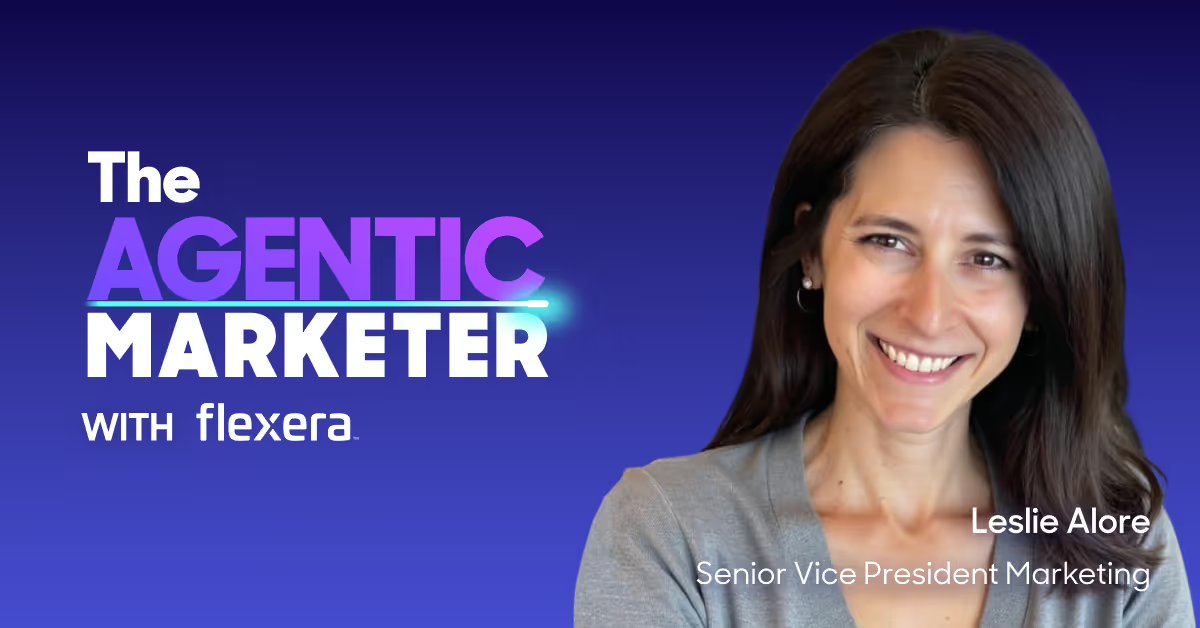
Episode 14 | Flexera on how agentic AI is reshaping B2B marketing
Flexera CMO Leslie Alore shares how agentic AI is reshaping B2B marketing, from content and research to AI SDRs, buyer expectations, and building modern marketing teams.


Flexera CMO Leslie Alore shares how agentic AI is reshaping B2B marketing, from content and research to AI SDRs, buyer expectations, and building modern marketing teams.

This episode of The Agentic Marketer features an interview with Leslie Alore, Chief Marketing Officer at Flexera, a technology company that helps organizations gain full visibility into their software and technology spend across increasingly complex tech stacks.
Leslie shares how her team at Flexera is adopting agentic marketing by pairing human marketers with AI agents to scale impact, improve buyer experience, and operate more efficiently. From using AI agents for content creation and research to piloting an AI SDR to qualify demand and book meetings, she offers a candid look at what’s working, what’s still experimental, and where marketers should start.
The conversation explores why experimentation is still essential in the AI era, how buyer expectations are shifting toward instant, zero-click experiences, and why marketers now need to think not only about human personas—but AI as an audience as well. Leslie also shares her perspective on managing AI agents like teammates, the skills marketing leaders need to double down on, and what’s coming next as AI becomes monetized and embedded into buyer journeys.
Key Takeaways
TRANSCRIPT
Sarah McConnell – Qualified
All right. Hi, Leslie. Thank you, Joyette, for joining us on The Agentic Marketer today. We’re so excited to have you here. But before we jump into any of our great content, first, can you just tell everyone listening who you are and tell us about the work that you’re doing over at Flexera?
Leslie Alore – Flexera
Absolutely. Well, thank you for having me. I’m Leslie Alore, and I’m the lucky lady who gets to lead the global marketing organization here at Flexera. We are a tech company that specializes in B2B SaaS applications for organizations looking to manage their software spend, and really any type of technology spend, whether that’s growing because of data clouds, or because of AI, or because of your licenses or SaaS.
We help organizations get full visibility into everything they’re spending money on across their tech stack and take control of it.
Sarah McConnell – Qualified
Amazing. Now, obviously the podcast is called The Agentic Marketer, so we always like to kick things off with asking what that term means to you, given it is a fairly new term. From your standpoint, how would you define agentic marketing? And more importantly, how does that differ from what you would view as what we all know is traditional marketing?
Leslie Alore – Flexera
Well, I think that the definition is changing really rapidly. Today, in this moment, what I’ll say is I would say an agentic marketer is somebody who effectively uses AI agents to manage the way that they market. They go to market out into the market, as well as manage the way that their teams work.
Sarah McConnell – Qualified
As all things in AI are.
Leslie Alore – Flexera
And this is a multifaceted opportunity to feed yourselves information, as well as use agents to push things.
Sarah McConnell – Qualified
Mm-hmm.
Sarah McConnell – Qualified
Yeah. And now I really like that answer because I do think, first of all, your preface of things change so quickly that here in this moment in time, here’s what that definition means, but who knows what it will mean later. So from your standpoint, traditional marketing is still what we’re all doing. Traditional marketing is up for debate on what that means, but we’re all still doing our marketing jobs.
But the agentic marketer is really using that assistance of agents to help them scale the scope of what they’re doing or the scale at which they can do their roles. I think it’s a really good way to think about agentic marketing, so I really like the way that you phrased that.
Leslie Alore – Flexera
Thank you. Yeah, you know, I think AI is a tool not unlike any other tool that we have at our disposal to use. I think, you know, if you think about how did people do marketing before the age of the internet, okay, well, did everything change? Most of it did. But you know what? We still get stuff in the mail. That’s like a thing that still happens, and apparently it’s on the rise. I learned that recently, and it shocked me. But I guess the younger generations find that very novel to get advertising in the mail. I find it very annoying.
But fundamentally, really well-utilized AI is a tool that makes your life and your ability to do your job easier, faster, and/or more scalable. And really, you want it to do all three of those things when you’re using it appropriately.
Sarah McConnell – Qualified
Absolutely. Now, I think a lot of people, especially in marketing, it can be hard to make this move from experimentation because, to your point, it is a tool. However, as marketers, we tend to be inundated with tools that we can use, and some of them stick, some of them don’t.
So for you and your team at Flexera, you’re obviously doing a really good job of turning yourselves into agentic marketers. What did it take, do you think, for you and your team to make that jump from experimenting with AI to really making it a part of your everyday tools that you have integrated into your team and you’re using to scale your marketing efforts?
Leslie Alore – Flexera
Well, I think actually experimenting is exactly the right way to start. And it will organically become part of the way that you work if you’re experimenting enough and incorrectly. You have to use it enough to understand both its abilities, but also its limitations.
If you’re only using it here and there, you’re like, this is amazing, it created this image for me, it did this thing over here. But you’re only doing it in little bits and bytes. You’re actually not coming up against the limitations, and therefore you could actually misuse it. And that makes it harder to really operationalize the way you bring it in.
You know, I don’t think that AI is far enough along for it to take over everything that you do. I still think that people should be in the mindset of experimentation, but find those repeated successes and start making those part of your operational procedure. You just have to.
In fact, Mark Cuban recently said on X, there’ll be two types of companies in the future: those that are great at AI and those that cease to exist.
Sarah McConnell – Qualified
I agree with you. I do think to the point of experimenting might be how you’re leading with AI right now. It doesn’t feel new anymore. I guess because we’re so deeply entrenched in it, AI doesn’t feel new, but it is still new in our industry.
If you think back to how these evolutions happen, experimentation is still almost leading with AI because you have to be experimenting with it in different areas. Now there might be, at least in our case, areas within our marketing organization where I would say we’re probably leading more with AI, and there are still other areas of our team where we’re still in experimentation mode.
But I agree with you, Leslie, that you have to be experimenting, you have to be comfortable with that, and I think also failing in order to feel like you’re going to, in the coming months and years, be a leader with AI on your team. So I really like that. It’s okay to be experimenting, and with experimenting, you still might be leading with AI at this point.
Leslie Alore – Flexera
And frankly, I’m just going to put this out there. All of marketing is an experiment all the time. Seriously, if you think that you have figured it out and then you’re just going to keep doing the same thing, I guarantee you that you’re missing a trick because the marketing world has always been changing dynamically. AI is just another flavor, another layer that gets added onto that.
Sarah McConnell – Qualified
Yeah, that is a rabbit hole I could spend a lot of time going down. Marketing is always like that. It’s always the perception of the individual and how you’re experimenting and trying new things.
Yes, to your point, direct mail is still around. We still get direct mail, and it’s cyclical. We’re doing outdoor boards and paid media, but you’re always experimenting with new ways. AI is just another piece of our constant experimentation in marketing.
Now I’m curious, as we talk about agentic and AI and experimentation, where do you currently see that experimentation with agents showing up most visibly within your marketing organization today?
Leslie Alore – Flexera
So, you know, at the risk of saying something that is predictable, content creation is still the most reliable place that you can really be using AI effectively, and specifically be using agents very, very well.
Using agents to write your copy, use separate agents to review your copy, use a different agent to be a thought partner with you on ideation for new creative or ways that you might go about reaching a particular audience. So thinking about using AI as an ideation generation partner.
And then I also really like it for doing research. You have to learn how to appropriately prompt to get reliable research. But we used to have to put out surveys and hire agencies and do all this complex stuff that took a very, very long time just to get what is kind of a basic collation of information back. And then you needed humans who understood your business to try to synthesize that information and say, okay, so what does this mean?
AI is great for that type of thing, and you can do it really, really quickly. So the new skill is less about conducting and synthesizing and analyzing the research and more about learning how to appropriately prompt AI to bring that insight back to you.
Sarah McConnell – Qualified
Yeah, you kind of mentioned content seems like the easiest one, but I think it was one of the first use cases for AI, and for a reason. You made the point of ideation. Ideation was always something we all struggled with.
While we’ve heard this over and over again, it’s said for a very good reason. It is one of the best use cases that I think you can be using agentic AI for as well, because ideation of content is hard. It’s hard to have a starting point.
Turning all of that content into repurposing takes a lot of time and effort and energy. Creating these things takes a lot, and then how are we getting it out there and getting the most usage out of it?
So for anyone listening to this, if you feel like content seems dated or like we should all be doing it but you’re not, it’s okay. Jump into it now because I think that is the one where it is a very easy stepping stone into use cases within your organization.
And don’t be afraid to say, yeah, this is where it’s most visibly showing up within our organization because there’s a good reason for that. It’s one of the ones we use most frequently as well.
Leslie Alore – Flexera
Yeah, and I think for people who haven’t used it, a different way to think about it might be it’s not about saying, here’s my outline, fill in the words. Give me the words. I mean, yeah, it can do that.
But what’s really interesting is that you can have a conversation with AI, like, I feel like this doesn’t come across as authoritative as I would want it to, or what do you think? If one of my competitors were to write this, how might they say it?
You almost have an opportunity to poke at it in different directions. It’s interesting because on one hand, AI is fun to interact with because it feels like you’re interacting with a human. However, at the same time, you can say things to AI that you might hold back from saying when you’re interacting with a human on your team.
In fact, years ago, I used to debate, do I hire an agency to write this thing or do I use my in-house copywriter? And a lot of times what would answer that question is, if I have a lot of feedback, am I going to make my copywriter cry? They’re my coworker. I don’t want to do that to them. I’m okay with doing that to an agency.
Well, we don’t have to worry about making AI cry.
Sarah McConnell – Qualified
Yeah. Because as you were saying this, I was giggling to myself because early days of ChatGPT, you were so nice to it. Please and thank you. But as we’ve gotten used to conversating with these LLMs, you can be very direct in a way you definitely wouldn’t be with your coworkers.
You don’t want to go back to your copywriter and say, write this six different ways from six different viewpoints. I’m not sure I’m going to use any of these things, but I just want to see what you come up with. That’s not a good use of their time.
So yes, it’s freeing to be direct with AI in a way you wouldn’t be with a human.
Leslie Alore – Flexera
Yeah, you know, on the flip side of that, I’m terrified for the next generation of people managers because everybody’s going to lose their social skills. All the baby marketers are learning how to instruct and direct AI, and they’re not necessarily using the same skills they’ll need to instruct, direct, influence, and motivate humans. So I’m afraid for our future.
Sarah McConnell – Qualified
Totally. That’s a really good point that I hadn’t thought about.
Sarah McConnell – Qualified
Totally. Yeah. That is a good point that I did not think about, that if that’s how you’re used to communicating at the start of your career, you have not learned the other side of that, which is how to communicate with your peers in a way that gets you effective work done.
So now, Leslie, we kind of mentioned where it’s showing up on your team here. We talked about content and research, but you guys have also been piloting an AI SDR, which we call Piper at Qualified. You might have named your AI SDR something different, as many companies do.
But I’m mainly curious, as people think about AI SDRs and as you think about your pilot program, what made you lean into wanting to test this out and see how it would impact your team? What made you lean into this concept?
Leslie Alore – Flexera
Okay. It was a multi-faceted motivation. Number one, I just believe this is the direction the world and the market is going. This is an absolutely fabulous use case for AI, and we’ve all experienced it already. We’ve been on the receiving end of it, but the experiences are actually getting better and better.
And in some cases, I believe that they can be better than the experience that you have with a human because they’re able to reference information much more quickly, to be much more responsive, to be available in an instant rather than a human trying to manage multiple things at once.
So actually, as our business started to grow and scale and become more complex, I was thinking, okay, we either have to really get better at the way that we enable the humans to be able to go find all the right information and be able to recall that information quickly. We need people to be available all the time to be able to respond in the moment that our customers are.
And by the way, buyers aren’t always trying to engage in those conversations during normal business hours. So it was kind of a multitude of reasons.
And I also kind of wanted a first pass at weeding out the noise that isn’t really a good use of our human talent’s time, and they were spending a lot of time on.
What we have found already through our use of Piper is we found that she—I think Piper is a she. I need to snap. So she’s done a great job weeding through those incoming requests and sorting them and figuring out where’s the real sales inquiries versus these are customer inquiries and partners over here.
She is really quick at grabbing the website visitors to interact and engage, especially those that are important to us. And we’ve seen about a 10% uptick in meeting bookings since we implemented Piper, probably for all the reasons I just mentioned.
And I think the other facet is just more immediacy. We all, all of us, myself included, want instant gratification. So when I initiate chat, it’s because I didn’t want to fill out your form, because I didn’t want to wait 24 hours for you to respond.
Sarah McConnell – Qualified
Yep. Yeah, the weeding through the noise—that is always a use case that I think tends to get overlooked. Obviously the things that we’re always thinking about with an AI SDR are meetings booked and speed to lead. I think those are the top of mind for every CMO, demand gen leader: can we respond to every single person at scale, and can we do it in a very quick manner?
Because so many people have been trained with B2C to want instant gratification, to your point, Leslie. But weeding through—we call them tire kickers—I didn’t realize how much time that took our human SDR team.
I would manage our Qualified instance and look at a lot of these and understand to a certain extent, but when we launched Piper on our site, we saw the sheer volume of even customers asking for customer documentation. Our human SDRs—they don’t benefit answering those questions.
Now they do it because they know that we want to give a good experience to our customers, and our customers are obviously expansion, and we treat them well because we should. But it does take a lot of their time, and they’re commissioned on net new bookings.
So having them spend time even with those quick responses does take time away from what they want to be doing to earn their paycheck. And until we launched Piper, I did not realize the extent at which they wasted that time.
So we were always concerned, how will our human SDRs feel working alongside this AI SDR? And what we found is they actually preferred it because it saved them so much time weeding through that noise that they wasted time on before. And it sounds like you guys have had a very similar experience.
Leslie Alore – Flexera
Yes, absolutely. In fact, we’re using AI in partnership with our many different AI tools in partnership with our SDR team, and they’ve probably been one of the earliest and most robust adopters of AI. It’s probably something about a generational aspect there with the SDRs as well. But it’s been incredibly, incredibly effective for them, and they’re happy to weed out the noise.
The other thing, the other side of that coin is, in the early days when chatbots and stuff first came out, I kind of felt like, am I not doing enough service to my customers? Am I downplaying the value of their experience by putting a piece of tech in front of them instead of a person? Is that disrespectful to the customer?
But now the technology has gotten so good, I actually think the customer experience is better. So it’s like, I’m investing in this thing so my customer experience can be better. Because if they’ve come in through the wrong chat forum, they don’t want to spend more time chatting with an SDR than they have to either.
Sarah McConnell – Qualified
Yeah, I could not agree more. I always share this story, but when we first launched Piper and I was trying to—we went through the phased rollout, because to your point, for our really high value target accounts, our customers, we want to make sure they were getting very high-touch experiences because again, that is good marketing. That is what they deserve, and that’s what we spend our time and effort on.
But there was one particular instance where someone asked a question, and I remember thinking, I didn’t know the answer to it. And if I didn’t know the answer to that question, our SDR team definitely wasn’t going to know the answer to this.
And the AI SDR was able to answer it very quickly and link to a resource that they were able to then visit very quickly and get their question answered, or redirect them in a way that my human SDR could never have done.
And the response would have been like, hold on, I’ll get back to you. What’s your email? I need to go Slack someone and try to find this answer and spend, at best, 24 hours trying to track this down. But it was instantaneous.
So I do agree with you, Leslie. It has gotten to the point where it is almost a better experience for those looking for that instant gratification that a human just could not provide for them.
Now, I want to shift gears a little bit into forward-looking, which I know is always hard because you kind of mentioned earlier, AI is changing at a very rapid rate.
But to kick things off with this forward-looking sentiment, if one of your marketing peers was coming to you, they listened to this episode and they’re like, “Leslie, it really sounds like you are doing a fantastic job at Flexera adopting AI,” where would you tell them to start? What advice would you give to a peer to tell them if they want to really step boldly into this agentic marketing era?
Leslie Alore – Flexera
You want to start with something that will get you a fast and easy win. So starting with something that helps you create content is the fastest, easiest way to see value. It’s the least intimidating. And I think it’s also the gateway drug to the ideation thought partner stuff that will take you down that path.
I would also say that you personally—you, the leader, you, the CMO, you, the whoever is trying to figure out how to implement this—needs to do it yourself. You need to be a user of it to understand the capabilities, the limitations, the interface, what it takes for other people, and what it took for you to learn enough to get comfortable.
Because if you’re just trying to chuck it over the fence and being like, “Figure it out, peeps, and let me know how it goes,” that’s probably not going to work. That’s my two cents.
Sarah McConnell – Qualified
Yep, I totally agree.
And then on that same note, we kind of talked about buyer expectations and you think AI SDRs might be providing potentially a better buyer experience based on the speed at which they can respond and find resources. Beyond that, do you think there is a buyer expectation that’s maybe been introduced in this AI era because a lot has changed?
I also think as buyers, we are always very influenced by B2C and how we’re interacting with the world outside of B2B marketing.
Is there something we as marketers you think are underestimating about buyer expectations in this age of AI that we should be focusing on right now?
Leslie Alore – Flexera
Yes. Two things.
Number one is I believe that the interface that we offer is going to matter a lot less than making sure that the content that we offer can be found by the interfaces they want to use, and those are going to be AI interfaces.
So whether that interface is your customer portal or your website or what have you, people are going to want to spend less time navigating to find stuff. They’re not going to want to click around. We’ve always as marketers wanted to reduce the number of clicks. People want no clicks at all.
They just want to interact with something that is going to answer all their questions. I’m going to tell you what I want, you’re going to tell me what I want to know.
Whether they go to your website and they’re just interacting with AI, or they’re using their chatbot of choice, that is definitely the future.
And the other thing I will say is don’t trick yourselves into thinking that the same rules don’t apply to AI as they do to humans in so far as propaganda and perception influence AI just as much as they influence people.
We would love to think that technology weeds out the noise of opinion and can get to the facts. That is not so.
So now, in addition to figuring out how to influence the perceptions of humans, you have to learn how to influence the perceptions of AI and the way that it presents that to the humans it’s talking to.
Sarah McConnell – Qualified
Yeah, that is another tangent I could spend a lot of time on because it is really interesting.
I think back to early days as we think about SEO versus what we call AEO or GEO or, to your point, LLM influence or AI influence. Early days of SEO, I remember keyword stuffing and there were all these hacks you could kind of get around to influence how you were being represented and how you were showing up.
And then it’s so interesting now that we’ve shifted into how people interact with AI, you can be more conversational. People want to come to that interface and have one singular conversation to get all their questions answered. They don’t want to leave. They don’t want to click. They want zero click.
And I feel like we’re almost back to the start of that, where there are different ways to influence AI that’s going to be different than what it was from an SEO perspective.
And we’re still in those early days of almost hacks of how can we all influence this in a way that benefits our organization. And eventually, as LLMs figure it out, it will change and it’s constantly going to be evolving.
But it’s almost fun to be back in those early stages again of SEO, where you could find those easy wins. Are we back in that same phase again now in how we can influence, and who’s going to figure that out first? Because people definitely are. I’ve seen it happening already.
Leslie Alore – Flexera
And by the way, we’re going to see the introduction of—you know, ChatGPT is going to be coming out with their ad platform. And so now the things that are going to influence these systems, these AIs, are also going to be monetizable or monetized in some way.
And so it’s not even like these AIs are only biased by the bias that we hack it to believe. They’re going to be biased by how much money they can make for the company that owns them.
Sarah McConnell – Qualified
Totally, and I think that’s a good segue to my next question: how do companies—what are the skills or what do companies need to be doubling down on in order to thrive in this AI-driven era?
Because as we just discussed, obviously that is changing. Traditional marketing—those things are still there, the foundations are still there—but there are things we’re going to have to double down on or change or shift our thinking on to thrive.
So what is something that you’re at least telling your marketing team, you’d give advice to peers, to double down on to thrive right now?
Leslie Alore – Flexera
So you’ve got to have all the technical skills, the AI-oriented technical skills, to make sure you’re managing the right schema. And you have to have the right content skills to manage the GEO or AISO or LLM visibility and all of the things.
But I would take that a step further and say you almost need to learn how AI behaves as an audience and what the AI watering hole is.
So if you think about your personas, you’ve got your user—if you’re in software, you’ve got a user persona who might be different than your buying decision maker persona, who might be different than the persona who’s influencing the buying process but isn’t known to you.
And then now you’ve got an AI persona in the mix that you have to speak to, so learning that and thinking that way is a necessary skill on the outward-facing perspective.
But on the inward-facing perspective, marketers just have to learn how to almost work with AI like their colleagues.
I have not, by the way, gone so far as to put AI agents on my org chart, and I’m not sure that I’ll ever get there. I know some people do.
But you almost do have to think about, when you think about the capabilities that help to support what it is your team is trying to do, you think, okay, here’s the people who execute this function. Here are my contractors. Here are my agencies. And here are my agents.
Sarah McConnell – Qualified
Mm-hmm. Yep. We also haven’t added them necessarily to our org chart, but I understand the benefit.
As we think about who’s being held responsible to an agent and how they are performing, obviously there has to be someone within your organization. And putting them on an org chart makes it a very easy line of sight into who on your team.
We have a couple of different agents. Obviously we have Piper, we have our outbound SDR agent, and we have very clear owners of those agents within our organization. So whether they are performing well, they’re not performing, we have someone to go to to say what’s working, what isn’t working, just like you would with anyone who’s managing them.
It does still feel a little hard to put them on an org chart, but I like the way you’re saying you have to think about that internally: you’ve got these people within these parts of your marketing team, and they’re going to work with agencies. They’re going to work with tools. And as part of that tool belt, they’re also going to have agents, and how are they making sure they’re performing right, and I guess also reading on the output of how they are performing.
Leslie Alore – Flexera
And be perpetually managing them. And I think that’s why they end up on org charts now. People are thinking, my gosh, there’s actually a lot of work and skill that goes into continuously managing these agents, especially if you’ve built them in-house, and that shouldn’t be underrepresented.
And knowing who has the skills to manage those agents is also important.
Sarah McConnell – Qualified
Absolutely.
Now, before we jump into our lightning round, which is how we wrap things up, I have one more question.
We’ve kind of talked about how AI agents are showing up within your organization right now from content or research. You’ve got Piper, your AI SDR agent. But looking forward, are there any other compelling use cases within marketing that you’re seeing AI agents start to emerge for, or any use cases that you’re wanting to see more AI agents emerge for that you think would benefit your organization?
Leslie Alore – Flexera
So, I mean, one of the things that I’ve been trying to figure out how to get really well packaged—and maybe it exists and I just haven’t gotten my hands on it yet—is something that is collating all of the multifaceted market insights into this perpetual feed and summary of what’s happening in my market, why does this matter, what does this mean for my business?
Like having an agent that can just kind of give that feed. Yes, I can have it give me the feed of the news. I can have it do competitive intel over here. But really collating it and flagging to me, like this is a big thing and this is why it matters, is something that I would love to see.
Because understanding your market, the dynamics of the market you’re in, your business, your customers, your competitors, is where you win or lose.
Sarah McConnell – Qualified
Yep, I totally agree.
Okay, to wrap things up, we do our lightning round. Quick questions, quick answers, just to make things a little more fun here.
So first question, Leslie: besides ChatGPT, because that tends to be everyone’s first response, what was the first AI tool that you experimented with in marketing?
Leslie Alore – Flexera
So Salesforce Einstein, and that was back in like 2015. And I know that some people have forgotten that machine learning is actually also AI, but it started there and I’m still a big fan of it. And I still use multiple types of machine learning.
Sarah McConnell – Qualified
I like that you’re throwing it way back 10 years ago. I was already using this.
Okay, most overrated buzzword you hear in martech right now.
Leslie Alore – Flexera
Agentic.
Sarah McConnell – Qualified
Yeah, that is fair, as the podcast name says, and I agree with you. I’m on the podcast and it is an overused term.
Okay, one marketer that you would tell our listeners to go follow who you think is ahead of the curve on AI, or that you’re really learning from an AI perspective.
Leslie Alore – Flexera
Lucian Louie, who is a former manager of mine from many, many years ago. He’s, I’m going to say retired from—he’s hung up his CMO hat. And now he’s really moved on to teaching and coaching and mentoring around how to evolve into an AI-led market.
Sarah McConnell – Qualified
Amazing.
Okay, and last question: if you could use AI to automate any part of your life outside of work, what would it be
Leslie Alore – Flexera
Weeding. I don’t know how that would make that happen, but.
Sarah McConnell – Qualified
That’s a really good answer. And I don’t know how that would work, but I would invest in it.
Leslie Alore – Flexera
And it’s like impossible to keep up with the weeds. Impossible.
Sarah McConnell – Qualified
You are very right. And then at a certain point you just give up and you just let them take over, and you’re like, you’ve won. I can’t. I simply can’t.
Okay, Leslie, well thank you so much for joining us on the podcast today. It was really great to have you and to get your insights.
Leslie Alore – Flexera
Thank you so much for having me, Sarah. I really appreciate it.
Stay up to date with weekly drops of fresh B2B marketing and sales content.
Flexera CMO Leslie Alore shares how agentic AI is reshaping B2B marketing, from content and research to AI SDRs, buyer expectations, and building modern marketing teams.


This episode of The Agentic Marketer features an interview with Leslie Alore, Chief Marketing Officer at Flexera, a technology company that helps organizations gain full visibility into their software and technology spend across increasingly complex tech stacks.
Leslie shares how her team at Flexera is adopting agentic marketing by pairing human marketers with AI agents to scale impact, improve buyer experience, and operate more efficiently. From using AI agents for content creation and research to piloting an AI SDR to qualify demand and book meetings, she offers a candid look at what’s working, what’s still experimental, and where marketers should start.
The conversation explores why experimentation is still essential in the AI era, how buyer expectations are shifting toward instant, zero-click experiences, and why marketers now need to think not only about human personas—but AI as an audience as well. Leslie also shares her perspective on managing AI agents like teammates, the skills marketing leaders need to double down on, and what’s coming next as AI becomes monetized and embedded into buyer journeys.
Key Takeaways
TRANSCRIPT
Sarah McConnell – Qualified
All right. Hi, Leslie. Thank you, Joyette, for joining us on The Agentic Marketer today. We’re so excited to have you here. But before we jump into any of our great content, first, can you just tell everyone listening who you are and tell us about the work that you’re doing over at Flexera?
Leslie Alore – Flexera
Absolutely. Well, thank you for having me. I’m Leslie Alore, and I’m the lucky lady who gets to lead the global marketing organization here at Flexera. We are a tech company that specializes in B2B SaaS applications for organizations looking to manage their software spend, and really any type of technology spend, whether that’s growing because of data clouds, or because of AI, or because of your licenses or SaaS.
We help organizations get full visibility into everything they’re spending money on across their tech stack and take control of it.
Sarah McConnell – Qualified
Amazing. Now, obviously the podcast is called The Agentic Marketer, so we always like to kick things off with asking what that term means to you, given it is a fairly new term. From your standpoint, how would you define agentic marketing? And more importantly, how does that differ from what you would view as what we all know is traditional marketing?
Leslie Alore – Flexera
Well, I think that the definition is changing really rapidly. Today, in this moment, what I’ll say is I would say an agentic marketer is somebody who effectively uses AI agents to manage the way that they market. They go to market out into the market, as well as manage the way that their teams work.
Sarah McConnell – Qualified
As all things in AI are.
Leslie Alore – Flexera
And this is a multifaceted opportunity to feed yourselves information, as well as use agents to push things.
Sarah McConnell – Qualified
Mm-hmm.
Sarah McConnell – Qualified
Yeah. And now I really like that answer because I do think, first of all, your preface of things change so quickly that here in this moment in time, here’s what that definition means, but who knows what it will mean later. So from your standpoint, traditional marketing is still what we’re all doing. Traditional marketing is up for debate on what that means, but we’re all still doing our marketing jobs.
But the agentic marketer is really using that assistance of agents to help them scale the scope of what they’re doing or the scale at which they can do their roles. I think it’s a really good way to think about agentic marketing, so I really like the way that you phrased that.
Leslie Alore – Flexera
Thank you. Yeah, you know, I think AI is a tool not unlike any other tool that we have at our disposal to use. I think, you know, if you think about how did people do marketing before the age of the internet, okay, well, did everything change? Most of it did. But you know what? We still get stuff in the mail. That’s like a thing that still happens, and apparently it’s on the rise. I learned that recently, and it shocked me. But I guess the younger generations find that very novel to get advertising in the mail. I find it very annoying.
But fundamentally, really well-utilized AI is a tool that makes your life and your ability to do your job easier, faster, and/or more scalable. And really, you want it to do all three of those things when you’re using it appropriately.
Sarah McConnell – Qualified
Absolutely. Now, I think a lot of people, especially in marketing, it can be hard to make this move from experimentation because, to your point, it is a tool. However, as marketers, we tend to be inundated with tools that we can use, and some of them stick, some of them don’t.
So for you and your team at Flexera, you’re obviously doing a really good job of turning yourselves into agentic marketers. What did it take, do you think, for you and your team to make that jump from experimenting with AI to really making it a part of your everyday tools that you have integrated into your team and you’re using to scale your marketing efforts?
Leslie Alore – Flexera
Well, I think actually experimenting is exactly the right way to start. And it will organically become part of the way that you work if you’re experimenting enough and incorrectly. You have to use it enough to understand both its abilities, but also its limitations.
If you’re only using it here and there, you’re like, this is amazing, it created this image for me, it did this thing over here. But you’re only doing it in little bits and bytes. You’re actually not coming up against the limitations, and therefore you could actually misuse it. And that makes it harder to really operationalize the way you bring it in.
You know, I don’t think that AI is far enough along for it to take over everything that you do. I still think that people should be in the mindset of experimentation, but find those repeated successes and start making those part of your operational procedure. You just have to.
In fact, Mark Cuban recently said on X, there’ll be two types of companies in the future: those that are great at AI and those that cease to exist.
Sarah McConnell – Qualified
I agree with you. I do think to the point of experimenting might be how you’re leading with AI right now. It doesn’t feel new anymore. I guess because we’re so deeply entrenched in it, AI doesn’t feel new, but it is still new in our industry.
If you think back to how these evolutions happen, experimentation is still almost leading with AI because you have to be experimenting with it in different areas. Now there might be, at least in our case, areas within our marketing organization where I would say we’re probably leading more with AI, and there are still other areas of our team where we’re still in experimentation mode.
But I agree with you, Leslie, that you have to be experimenting, you have to be comfortable with that, and I think also failing in order to feel like you’re going to, in the coming months and years, be a leader with AI on your team. So I really like that. It’s okay to be experimenting, and with experimenting, you still might be leading with AI at this point.
Leslie Alore – Flexera
And frankly, I’m just going to put this out there. All of marketing is an experiment all the time. Seriously, if you think that you have figured it out and then you’re just going to keep doing the same thing, I guarantee you that you’re missing a trick because the marketing world has always been changing dynamically. AI is just another flavor, another layer that gets added onto that.
Sarah McConnell – Qualified
Yeah, that is a rabbit hole I could spend a lot of time going down. Marketing is always like that. It’s always the perception of the individual and how you’re experimenting and trying new things.
Yes, to your point, direct mail is still around. We still get direct mail, and it’s cyclical. We’re doing outdoor boards and paid media, but you’re always experimenting with new ways. AI is just another piece of our constant experimentation in marketing.
Now I’m curious, as we talk about agentic and AI and experimentation, where do you currently see that experimentation with agents showing up most visibly within your marketing organization today?
Leslie Alore – Flexera
So, you know, at the risk of saying something that is predictable, content creation is still the most reliable place that you can really be using AI effectively, and specifically be using agents very, very well.
Using agents to write your copy, use separate agents to review your copy, use a different agent to be a thought partner with you on ideation for new creative or ways that you might go about reaching a particular audience. So thinking about using AI as an ideation generation partner.
And then I also really like it for doing research. You have to learn how to appropriately prompt to get reliable research. But we used to have to put out surveys and hire agencies and do all this complex stuff that took a very, very long time just to get what is kind of a basic collation of information back. And then you needed humans who understood your business to try to synthesize that information and say, okay, so what does this mean?
AI is great for that type of thing, and you can do it really, really quickly. So the new skill is less about conducting and synthesizing and analyzing the research and more about learning how to appropriately prompt AI to bring that insight back to you.
Sarah McConnell – Qualified
Yeah, you kind of mentioned content seems like the easiest one, but I think it was one of the first use cases for AI, and for a reason. You made the point of ideation. Ideation was always something we all struggled with.
While we’ve heard this over and over again, it’s said for a very good reason. It is one of the best use cases that I think you can be using agentic AI for as well, because ideation of content is hard. It’s hard to have a starting point.
Turning all of that content into repurposing takes a lot of time and effort and energy. Creating these things takes a lot, and then how are we getting it out there and getting the most usage out of it?
So for anyone listening to this, if you feel like content seems dated or like we should all be doing it but you’re not, it’s okay. Jump into it now because I think that is the one where it is a very easy stepping stone into use cases within your organization.
And don’t be afraid to say, yeah, this is where it’s most visibly showing up within our organization because there’s a good reason for that. It’s one of the ones we use most frequently as well.
Leslie Alore – Flexera
Yeah, and I think for people who haven’t used it, a different way to think about it might be it’s not about saying, here’s my outline, fill in the words. Give me the words. I mean, yeah, it can do that.
But what’s really interesting is that you can have a conversation with AI, like, I feel like this doesn’t come across as authoritative as I would want it to, or what do you think? If one of my competitors were to write this, how might they say it?
You almost have an opportunity to poke at it in different directions. It’s interesting because on one hand, AI is fun to interact with because it feels like you’re interacting with a human. However, at the same time, you can say things to AI that you might hold back from saying when you’re interacting with a human on your team.
In fact, years ago, I used to debate, do I hire an agency to write this thing or do I use my in-house copywriter? And a lot of times what would answer that question is, if I have a lot of feedback, am I going to make my copywriter cry? They’re my coworker. I don’t want to do that to them. I’m okay with doing that to an agency.
Well, we don’t have to worry about making AI cry.
Sarah McConnell – Qualified
Yeah. Because as you were saying this, I was giggling to myself because early days of ChatGPT, you were so nice to it. Please and thank you. But as we’ve gotten used to conversating with these LLMs, you can be very direct in a way you definitely wouldn’t be with your coworkers.
You don’t want to go back to your copywriter and say, write this six different ways from six different viewpoints. I’m not sure I’m going to use any of these things, but I just want to see what you come up with. That’s not a good use of their time.
So yes, it’s freeing to be direct with AI in a way you wouldn’t be with a human.
Leslie Alore – Flexera
Yeah, you know, on the flip side of that, I’m terrified for the next generation of people managers because everybody’s going to lose their social skills. All the baby marketers are learning how to instruct and direct AI, and they’re not necessarily using the same skills they’ll need to instruct, direct, influence, and motivate humans. So I’m afraid for our future.
Sarah McConnell – Qualified
Totally. That’s a really good point that I hadn’t thought about.
Sarah McConnell – Qualified
Totally. Yeah. That is a good point that I did not think about, that if that’s how you’re used to communicating at the start of your career, you have not learned the other side of that, which is how to communicate with your peers in a way that gets you effective work done.
So now, Leslie, we kind of mentioned where it’s showing up on your team here. We talked about content and research, but you guys have also been piloting an AI SDR, which we call Piper at Qualified. You might have named your AI SDR something different, as many companies do.
But I’m mainly curious, as people think about AI SDRs and as you think about your pilot program, what made you lean into wanting to test this out and see how it would impact your team? What made you lean into this concept?
Leslie Alore – Flexera
Okay. It was a multi-faceted motivation. Number one, I just believe this is the direction the world and the market is going. This is an absolutely fabulous use case for AI, and we’ve all experienced it already. We’ve been on the receiving end of it, but the experiences are actually getting better and better.
And in some cases, I believe that they can be better than the experience that you have with a human because they’re able to reference information much more quickly, to be much more responsive, to be available in an instant rather than a human trying to manage multiple things at once.
So actually, as our business started to grow and scale and become more complex, I was thinking, okay, we either have to really get better at the way that we enable the humans to be able to go find all the right information and be able to recall that information quickly. We need people to be available all the time to be able to respond in the moment that our customers are.
And by the way, buyers aren’t always trying to engage in those conversations during normal business hours. So it was kind of a multitude of reasons.
And I also kind of wanted a first pass at weeding out the noise that isn’t really a good use of our human talent’s time, and they were spending a lot of time on.
What we have found already through our use of Piper is we found that she—I think Piper is a she. I need to snap. So she’s done a great job weeding through those incoming requests and sorting them and figuring out where’s the real sales inquiries versus these are customer inquiries and partners over here.
She is really quick at grabbing the website visitors to interact and engage, especially those that are important to us. And we’ve seen about a 10% uptick in meeting bookings since we implemented Piper, probably for all the reasons I just mentioned.
And I think the other facet is just more immediacy. We all, all of us, myself included, want instant gratification. So when I initiate chat, it’s because I didn’t want to fill out your form, because I didn’t want to wait 24 hours for you to respond.
Sarah McConnell – Qualified
Yep. Yeah, the weeding through the noise—that is always a use case that I think tends to get overlooked. Obviously the things that we’re always thinking about with an AI SDR are meetings booked and speed to lead. I think those are the top of mind for every CMO, demand gen leader: can we respond to every single person at scale, and can we do it in a very quick manner?
Because so many people have been trained with B2C to want instant gratification, to your point, Leslie. But weeding through—we call them tire kickers—I didn’t realize how much time that took our human SDR team.
I would manage our Qualified instance and look at a lot of these and understand to a certain extent, but when we launched Piper on our site, we saw the sheer volume of even customers asking for customer documentation. Our human SDRs—they don’t benefit answering those questions.
Now they do it because they know that we want to give a good experience to our customers, and our customers are obviously expansion, and we treat them well because we should. But it does take a lot of their time, and they’re commissioned on net new bookings.
So having them spend time even with those quick responses does take time away from what they want to be doing to earn their paycheck. And until we launched Piper, I did not realize the extent at which they wasted that time.
So we were always concerned, how will our human SDRs feel working alongside this AI SDR? And what we found is they actually preferred it because it saved them so much time weeding through that noise that they wasted time on before. And it sounds like you guys have had a very similar experience.
Leslie Alore – Flexera
Yes, absolutely. In fact, we’re using AI in partnership with our many different AI tools in partnership with our SDR team, and they’ve probably been one of the earliest and most robust adopters of AI. It’s probably something about a generational aspect there with the SDRs as well. But it’s been incredibly, incredibly effective for them, and they’re happy to weed out the noise.
The other thing, the other side of that coin is, in the early days when chatbots and stuff first came out, I kind of felt like, am I not doing enough service to my customers? Am I downplaying the value of their experience by putting a piece of tech in front of them instead of a person? Is that disrespectful to the customer?
But now the technology has gotten so good, I actually think the customer experience is better. So it’s like, I’m investing in this thing so my customer experience can be better. Because if they’ve come in through the wrong chat forum, they don’t want to spend more time chatting with an SDR than they have to either.
Sarah McConnell – Qualified
Yeah, I could not agree more. I always share this story, but when we first launched Piper and I was trying to—we went through the phased rollout, because to your point, for our really high value target accounts, our customers, we want to make sure they were getting very high-touch experiences because again, that is good marketing. That is what they deserve, and that’s what we spend our time and effort on.
But there was one particular instance where someone asked a question, and I remember thinking, I didn’t know the answer to it. And if I didn’t know the answer to that question, our SDR team definitely wasn’t going to know the answer to this.
And the AI SDR was able to answer it very quickly and link to a resource that they were able to then visit very quickly and get their question answered, or redirect them in a way that my human SDR could never have done.
And the response would have been like, hold on, I’ll get back to you. What’s your email? I need to go Slack someone and try to find this answer and spend, at best, 24 hours trying to track this down. But it was instantaneous.
So I do agree with you, Leslie. It has gotten to the point where it is almost a better experience for those looking for that instant gratification that a human just could not provide for them.
Now, I want to shift gears a little bit into forward-looking, which I know is always hard because you kind of mentioned earlier, AI is changing at a very rapid rate.
But to kick things off with this forward-looking sentiment, if one of your marketing peers was coming to you, they listened to this episode and they’re like, “Leslie, it really sounds like you are doing a fantastic job at Flexera adopting AI,” where would you tell them to start? What advice would you give to a peer to tell them if they want to really step boldly into this agentic marketing era?
Leslie Alore – Flexera
You want to start with something that will get you a fast and easy win. So starting with something that helps you create content is the fastest, easiest way to see value. It’s the least intimidating. And I think it’s also the gateway drug to the ideation thought partner stuff that will take you down that path.
I would also say that you personally—you, the leader, you, the CMO, you, the whoever is trying to figure out how to implement this—needs to do it yourself. You need to be a user of it to understand the capabilities, the limitations, the interface, what it takes for other people, and what it took for you to learn enough to get comfortable.
Because if you’re just trying to chuck it over the fence and being like, “Figure it out, peeps, and let me know how it goes,” that’s probably not going to work. That’s my two cents.
Sarah McConnell – Qualified
Yep, I totally agree.
And then on that same note, we kind of talked about buyer expectations and you think AI SDRs might be providing potentially a better buyer experience based on the speed at which they can respond and find resources. Beyond that, do you think there is a buyer expectation that’s maybe been introduced in this AI era because a lot has changed?
I also think as buyers, we are always very influenced by B2C and how we’re interacting with the world outside of B2B marketing.
Is there something we as marketers you think are underestimating about buyer expectations in this age of AI that we should be focusing on right now?
Leslie Alore – Flexera
Yes. Two things.
Number one is I believe that the interface that we offer is going to matter a lot less than making sure that the content that we offer can be found by the interfaces they want to use, and those are going to be AI interfaces.
So whether that interface is your customer portal or your website or what have you, people are going to want to spend less time navigating to find stuff. They’re not going to want to click around. We’ve always as marketers wanted to reduce the number of clicks. People want no clicks at all.
They just want to interact with something that is going to answer all their questions. I’m going to tell you what I want, you’re going to tell me what I want to know.
Whether they go to your website and they’re just interacting with AI, or they’re using their chatbot of choice, that is definitely the future.
And the other thing I will say is don’t trick yourselves into thinking that the same rules don’t apply to AI as they do to humans in so far as propaganda and perception influence AI just as much as they influence people.
We would love to think that technology weeds out the noise of opinion and can get to the facts. That is not so.
So now, in addition to figuring out how to influence the perceptions of humans, you have to learn how to influence the perceptions of AI and the way that it presents that to the humans it’s talking to.
Sarah McConnell – Qualified
Yeah, that is another tangent I could spend a lot of time on because it is really interesting.
I think back to early days as we think about SEO versus what we call AEO or GEO or, to your point, LLM influence or AI influence. Early days of SEO, I remember keyword stuffing and there were all these hacks you could kind of get around to influence how you were being represented and how you were showing up.
And then it’s so interesting now that we’ve shifted into how people interact with AI, you can be more conversational. People want to come to that interface and have one singular conversation to get all their questions answered. They don’t want to leave. They don’t want to click. They want zero click.
And I feel like we’re almost back to the start of that, where there are different ways to influence AI that’s going to be different than what it was from an SEO perspective.
And we’re still in those early days of almost hacks of how can we all influence this in a way that benefits our organization. And eventually, as LLMs figure it out, it will change and it’s constantly going to be evolving.
But it’s almost fun to be back in those early stages again of SEO, where you could find those easy wins. Are we back in that same phase again now in how we can influence, and who’s going to figure that out first? Because people definitely are. I’ve seen it happening already.
Leslie Alore – Flexera
And by the way, we’re going to see the introduction of—you know, ChatGPT is going to be coming out with their ad platform. And so now the things that are going to influence these systems, these AIs, are also going to be monetizable or monetized in some way.
And so it’s not even like these AIs are only biased by the bias that we hack it to believe. They’re going to be biased by how much money they can make for the company that owns them.
Sarah McConnell – Qualified
Totally, and I think that’s a good segue to my next question: how do companies—what are the skills or what do companies need to be doubling down on in order to thrive in this AI-driven era?
Because as we just discussed, obviously that is changing. Traditional marketing—those things are still there, the foundations are still there—but there are things we’re going to have to double down on or change or shift our thinking on to thrive.
So what is something that you’re at least telling your marketing team, you’d give advice to peers, to double down on to thrive right now?
Leslie Alore – Flexera
So you’ve got to have all the technical skills, the AI-oriented technical skills, to make sure you’re managing the right schema. And you have to have the right content skills to manage the GEO or AISO or LLM visibility and all of the things.
But I would take that a step further and say you almost need to learn how AI behaves as an audience and what the AI watering hole is.
So if you think about your personas, you’ve got your user—if you’re in software, you’ve got a user persona who might be different than your buying decision maker persona, who might be different than the persona who’s influencing the buying process but isn’t known to you.
And then now you’ve got an AI persona in the mix that you have to speak to, so learning that and thinking that way is a necessary skill on the outward-facing perspective.
But on the inward-facing perspective, marketers just have to learn how to almost work with AI like their colleagues.
I have not, by the way, gone so far as to put AI agents on my org chart, and I’m not sure that I’ll ever get there. I know some people do.
But you almost do have to think about, when you think about the capabilities that help to support what it is your team is trying to do, you think, okay, here’s the people who execute this function. Here are my contractors. Here are my agencies. And here are my agents.
Sarah McConnell – Qualified
Mm-hmm. Yep. We also haven’t added them necessarily to our org chart, but I understand the benefit.
As we think about who’s being held responsible to an agent and how they are performing, obviously there has to be someone within your organization. And putting them on an org chart makes it a very easy line of sight into who on your team.
We have a couple of different agents. Obviously we have Piper, we have our outbound SDR agent, and we have very clear owners of those agents within our organization. So whether they are performing well, they’re not performing, we have someone to go to to say what’s working, what isn’t working, just like you would with anyone who’s managing them.
It does still feel a little hard to put them on an org chart, but I like the way you’re saying you have to think about that internally: you’ve got these people within these parts of your marketing team, and they’re going to work with agencies. They’re going to work with tools. And as part of that tool belt, they’re also going to have agents, and how are they making sure they’re performing right, and I guess also reading on the output of how they are performing.
Leslie Alore – Flexera
And be perpetually managing them. And I think that’s why they end up on org charts now. People are thinking, my gosh, there’s actually a lot of work and skill that goes into continuously managing these agents, especially if you’ve built them in-house, and that shouldn’t be underrepresented.
And knowing who has the skills to manage those agents is also important.
Sarah McConnell – Qualified
Absolutely.
Now, before we jump into our lightning round, which is how we wrap things up, I have one more question.
We’ve kind of talked about how AI agents are showing up within your organization right now from content or research. You’ve got Piper, your AI SDR agent. But looking forward, are there any other compelling use cases within marketing that you’re seeing AI agents start to emerge for, or any use cases that you’re wanting to see more AI agents emerge for that you think would benefit your organization?
Leslie Alore – Flexera
So, I mean, one of the things that I’ve been trying to figure out how to get really well packaged—and maybe it exists and I just haven’t gotten my hands on it yet—is something that is collating all of the multifaceted market insights into this perpetual feed and summary of what’s happening in my market, why does this matter, what does this mean for my business?
Like having an agent that can just kind of give that feed. Yes, I can have it give me the feed of the news. I can have it do competitive intel over here. But really collating it and flagging to me, like this is a big thing and this is why it matters, is something that I would love to see.
Because understanding your market, the dynamics of the market you’re in, your business, your customers, your competitors, is where you win or lose.
Sarah McConnell – Qualified
Yep, I totally agree.
Okay, to wrap things up, we do our lightning round. Quick questions, quick answers, just to make things a little more fun here.
So first question, Leslie: besides ChatGPT, because that tends to be everyone’s first response, what was the first AI tool that you experimented with in marketing?
Leslie Alore – Flexera
So Salesforce Einstein, and that was back in like 2015. And I know that some people have forgotten that machine learning is actually also AI, but it started there and I’m still a big fan of it. And I still use multiple types of machine learning.
Sarah McConnell – Qualified
I like that you’re throwing it way back 10 years ago. I was already using this.
Okay, most overrated buzzword you hear in martech right now.
Leslie Alore – Flexera
Agentic.
Sarah McConnell – Qualified
Yeah, that is fair, as the podcast name says, and I agree with you. I’m on the podcast and it is an overused term.
Okay, one marketer that you would tell our listeners to go follow who you think is ahead of the curve on AI, or that you’re really learning from an AI perspective.
Leslie Alore – Flexera
Lucian Louie, who is a former manager of mine from many, many years ago. He’s, I’m going to say retired from—he’s hung up his CMO hat. And now he’s really moved on to teaching and coaching and mentoring around how to evolve into an AI-led market.
Sarah McConnell – Qualified
Amazing.
Okay, and last question: if you could use AI to automate any part of your life outside of work, what would it be
Leslie Alore – Flexera
Weeding. I don’t know how that would make that happen, but.
Sarah McConnell – Qualified
That’s a really good answer. And I don’t know how that would work, but I would invest in it.
Leslie Alore – Flexera
And it’s like impossible to keep up with the weeds. Impossible.
Sarah McConnell – Qualified
You are very right. And then at a certain point you just give up and you just let them take over, and you’re like, you’ve won. I can’t. I simply can’t.
Okay, Leslie, well thank you so much for joining us on the podcast today. It was really great to have you and to get your insights.
Leslie Alore – Flexera
Thank you so much for having me, Sarah. I really appreciate it.
Stay up to date with weekly drops of fresh B2B marketing and sales content.
Flexera CMO Leslie Alore shares how agentic AI is reshaping B2B marketing, from content and research to AI SDRs, buyer expectations, and building modern marketing teams.


This episode of The Agentic Marketer features an interview with Leslie Alore, Chief Marketing Officer at Flexera, a technology company that helps organizations gain full visibility into their software and technology spend across increasingly complex tech stacks.
Leslie shares how her team at Flexera is adopting agentic marketing by pairing human marketers with AI agents to scale impact, improve buyer experience, and operate more efficiently. From using AI agents for content creation and research to piloting an AI SDR to qualify demand and book meetings, she offers a candid look at what’s working, what’s still experimental, and where marketers should start.
The conversation explores why experimentation is still essential in the AI era, how buyer expectations are shifting toward instant, zero-click experiences, and why marketers now need to think not only about human personas—but AI as an audience as well. Leslie also shares her perspective on managing AI agents like teammates, the skills marketing leaders need to double down on, and what’s coming next as AI becomes monetized and embedded into buyer journeys.
Key Takeaways
TRANSCRIPT
Sarah McConnell – Qualified
All right. Hi, Leslie. Thank you, Joyette, for joining us on The Agentic Marketer today. We’re so excited to have you here. But before we jump into any of our great content, first, can you just tell everyone listening who you are and tell us about the work that you’re doing over at Flexera?
Leslie Alore – Flexera
Absolutely. Well, thank you for having me. I’m Leslie Alore, and I’m the lucky lady who gets to lead the global marketing organization here at Flexera. We are a tech company that specializes in B2B SaaS applications for organizations looking to manage their software spend, and really any type of technology spend, whether that’s growing because of data clouds, or because of AI, or because of your licenses or SaaS.
We help organizations get full visibility into everything they’re spending money on across their tech stack and take control of it.
Sarah McConnell – Qualified
Amazing. Now, obviously the podcast is called The Agentic Marketer, so we always like to kick things off with asking what that term means to you, given it is a fairly new term. From your standpoint, how would you define agentic marketing? And more importantly, how does that differ from what you would view as what we all know is traditional marketing?
Leslie Alore – Flexera
Well, I think that the definition is changing really rapidly. Today, in this moment, what I’ll say is I would say an agentic marketer is somebody who effectively uses AI agents to manage the way that they market. They go to market out into the market, as well as manage the way that their teams work.
Sarah McConnell – Qualified
As all things in AI are.
Leslie Alore – Flexera
And this is a multifaceted opportunity to feed yourselves information, as well as use agents to push things.
Sarah McConnell – Qualified
Mm-hmm.
Sarah McConnell – Qualified
Yeah. And now I really like that answer because I do think, first of all, your preface of things change so quickly that here in this moment in time, here’s what that definition means, but who knows what it will mean later. So from your standpoint, traditional marketing is still what we’re all doing. Traditional marketing is up for debate on what that means, but we’re all still doing our marketing jobs.
But the agentic marketer is really using that assistance of agents to help them scale the scope of what they’re doing or the scale at which they can do their roles. I think it’s a really good way to think about agentic marketing, so I really like the way that you phrased that.
Leslie Alore – Flexera
Thank you. Yeah, you know, I think AI is a tool not unlike any other tool that we have at our disposal to use. I think, you know, if you think about how did people do marketing before the age of the internet, okay, well, did everything change? Most of it did. But you know what? We still get stuff in the mail. That’s like a thing that still happens, and apparently it’s on the rise. I learned that recently, and it shocked me. But I guess the younger generations find that very novel to get advertising in the mail. I find it very annoying.
But fundamentally, really well-utilized AI is a tool that makes your life and your ability to do your job easier, faster, and/or more scalable. And really, you want it to do all three of those things when you’re using it appropriately.
Sarah McConnell – Qualified
Absolutely. Now, I think a lot of people, especially in marketing, it can be hard to make this move from experimentation because, to your point, it is a tool. However, as marketers, we tend to be inundated with tools that we can use, and some of them stick, some of them don’t.
So for you and your team at Flexera, you’re obviously doing a really good job of turning yourselves into agentic marketers. What did it take, do you think, for you and your team to make that jump from experimenting with AI to really making it a part of your everyday tools that you have integrated into your team and you’re using to scale your marketing efforts?
Leslie Alore – Flexera
Well, I think actually experimenting is exactly the right way to start. And it will organically become part of the way that you work if you’re experimenting enough and incorrectly. You have to use it enough to understand both its abilities, but also its limitations.
If you’re only using it here and there, you’re like, this is amazing, it created this image for me, it did this thing over here. But you’re only doing it in little bits and bytes. You’re actually not coming up against the limitations, and therefore you could actually misuse it. And that makes it harder to really operationalize the way you bring it in.
You know, I don’t think that AI is far enough along for it to take over everything that you do. I still think that people should be in the mindset of experimentation, but find those repeated successes and start making those part of your operational procedure. You just have to.
In fact, Mark Cuban recently said on X, there’ll be two types of companies in the future: those that are great at AI and those that cease to exist.
Sarah McConnell – Qualified
I agree with you. I do think to the point of experimenting might be how you’re leading with AI right now. It doesn’t feel new anymore. I guess because we’re so deeply entrenched in it, AI doesn’t feel new, but it is still new in our industry.
If you think back to how these evolutions happen, experimentation is still almost leading with AI because you have to be experimenting with it in different areas. Now there might be, at least in our case, areas within our marketing organization where I would say we’re probably leading more with AI, and there are still other areas of our team where we’re still in experimentation mode.
But I agree with you, Leslie, that you have to be experimenting, you have to be comfortable with that, and I think also failing in order to feel like you’re going to, in the coming months and years, be a leader with AI on your team. So I really like that. It’s okay to be experimenting, and with experimenting, you still might be leading with AI at this point.
Leslie Alore – Flexera
And frankly, I’m just going to put this out there. All of marketing is an experiment all the time. Seriously, if you think that you have figured it out and then you’re just going to keep doing the same thing, I guarantee you that you’re missing a trick because the marketing world has always been changing dynamically. AI is just another flavor, another layer that gets added onto that.
Sarah McConnell – Qualified
Yeah, that is a rabbit hole I could spend a lot of time going down. Marketing is always like that. It’s always the perception of the individual and how you’re experimenting and trying new things.
Yes, to your point, direct mail is still around. We still get direct mail, and it’s cyclical. We’re doing outdoor boards and paid media, but you’re always experimenting with new ways. AI is just another piece of our constant experimentation in marketing.
Now I’m curious, as we talk about agentic and AI and experimentation, where do you currently see that experimentation with agents showing up most visibly within your marketing organization today?
Leslie Alore – Flexera
So, you know, at the risk of saying something that is predictable, content creation is still the most reliable place that you can really be using AI effectively, and specifically be using agents very, very well.
Using agents to write your copy, use separate agents to review your copy, use a different agent to be a thought partner with you on ideation for new creative or ways that you might go about reaching a particular audience. So thinking about using AI as an ideation generation partner.
And then I also really like it for doing research. You have to learn how to appropriately prompt to get reliable research. But we used to have to put out surveys and hire agencies and do all this complex stuff that took a very, very long time just to get what is kind of a basic collation of information back. And then you needed humans who understood your business to try to synthesize that information and say, okay, so what does this mean?
AI is great for that type of thing, and you can do it really, really quickly. So the new skill is less about conducting and synthesizing and analyzing the research and more about learning how to appropriately prompt AI to bring that insight back to you.
Sarah McConnell – Qualified
Yeah, you kind of mentioned content seems like the easiest one, but I think it was one of the first use cases for AI, and for a reason. You made the point of ideation. Ideation was always something we all struggled with.
While we’ve heard this over and over again, it’s said for a very good reason. It is one of the best use cases that I think you can be using agentic AI for as well, because ideation of content is hard. It’s hard to have a starting point.
Turning all of that content into repurposing takes a lot of time and effort and energy. Creating these things takes a lot, and then how are we getting it out there and getting the most usage out of it?
So for anyone listening to this, if you feel like content seems dated or like we should all be doing it but you’re not, it’s okay. Jump into it now because I think that is the one where it is a very easy stepping stone into use cases within your organization.
And don’t be afraid to say, yeah, this is where it’s most visibly showing up within our organization because there’s a good reason for that. It’s one of the ones we use most frequently as well.
Leslie Alore – Flexera
Yeah, and I think for people who haven’t used it, a different way to think about it might be it’s not about saying, here’s my outline, fill in the words. Give me the words. I mean, yeah, it can do that.
But what’s really interesting is that you can have a conversation with AI, like, I feel like this doesn’t come across as authoritative as I would want it to, or what do you think? If one of my competitors were to write this, how might they say it?
You almost have an opportunity to poke at it in different directions. It’s interesting because on one hand, AI is fun to interact with because it feels like you’re interacting with a human. However, at the same time, you can say things to AI that you might hold back from saying when you’re interacting with a human on your team.
In fact, years ago, I used to debate, do I hire an agency to write this thing or do I use my in-house copywriter? And a lot of times what would answer that question is, if I have a lot of feedback, am I going to make my copywriter cry? They’re my coworker. I don’t want to do that to them. I’m okay with doing that to an agency.
Well, we don’t have to worry about making AI cry.
Sarah McConnell – Qualified
Yeah. Because as you were saying this, I was giggling to myself because early days of ChatGPT, you were so nice to it. Please and thank you. But as we’ve gotten used to conversating with these LLMs, you can be very direct in a way you definitely wouldn’t be with your coworkers.
You don’t want to go back to your copywriter and say, write this six different ways from six different viewpoints. I’m not sure I’m going to use any of these things, but I just want to see what you come up with. That’s not a good use of their time.
So yes, it’s freeing to be direct with AI in a way you wouldn’t be with a human.
Leslie Alore – Flexera
Yeah, you know, on the flip side of that, I’m terrified for the next generation of people managers because everybody’s going to lose their social skills. All the baby marketers are learning how to instruct and direct AI, and they’re not necessarily using the same skills they’ll need to instruct, direct, influence, and motivate humans. So I’m afraid for our future.
Sarah McConnell – Qualified
Totally. That’s a really good point that I hadn’t thought about.
Sarah McConnell – Qualified
Totally. Yeah. That is a good point that I did not think about, that if that’s how you’re used to communicating at the start of your career, you have not learned the other side of that, which is how to communicate with your peers in a way that gets you effective work done.
So now, Leslie, we kind of mentioned where it’s showing up on your team here. We talked about content and research, but you guys have also been piloting an AI SDR, which we call Piper at Qualified. You might have named your AI SDR something different, as many companies do.
But I’m mainly curious, as people think about AI SDRs and as you think about your pilot program, what made you lean into wanting to test this out and see how it would impact your team? What made you lean into this concept?
Leslie Alore – Flexera
Okay. It was a multi-faceted motivation. Number one, I just believe this is the direction the world and the market is going. This is an absolutely fabulous use case for AI, and we’ve all experienced it already. We’ve been on the receiving end of it, but the experiences are actually getting better and better.
And in some cases, I believe that they can be better than the experience that you have with a human because they’re able to reference information much more quickly, to be much more responsive, to be available in an instant rather than a human trying to manage multiple things at once.
So actually, as our business started to grow and scale and become more complex, I was thinking, okay, we either have to really get better at the way that we enable the humans to be able to go find all the right information and be able to recall that information quickly. We need people to be available all the time to be able to respond in the moment that our customers are.
And by the way, buyers aren’t always trying to engage in those conversations during normal business hours. So it was kind of a multitude of reasons.
And I also kind of wanted a first pass at weeding out the noise that isn’t really a good use of our human talent’s time, and they were spending a lot of time on.
What we have found already through our use of Piper is we found that she—I think Piper is a she. I need to snap. So she’s done a great job weeding through those incoming requests and sorting them and figuring out where’s the real sales inquiries versus these are customer inquiries and partners over here.
She is really quick at grabbing the website visitors to interact and engage, especially those that are important to us. And we’ve seen about a 10% uptick in meeting bookings since we implemented Piper, probably for all the reasons I just mentioned.
And I think the other facet is just more immediacy. We all, all of us, myself included, want instant gratification. So when I initiate chat, it’s because I didn’t want to fill out your form, because I didn’t want to wait 24 hours for you to respond.
Sarah McConnell – Qualified
Yep. Yeah, the weeding through the noise—that is always a use case that I think tends to get overlooked. Obviously the things that we’re always thinking about with an AI SDR are meetings booked and speed to lead. I think those are the top of mind for every CMO, demand gen leader: can we respond to every single person at scale, and can we do it in a very quick manner?
Because so many people have been trained with B2C to want instant gratification, to your point, Leslie. But weeding through—we call them tire kickers—I didn’t realize how much time that took our human SDR team.
I would manage our Qualified instance and look at a lot of these and understand to a certain extent, but when we launched Piper on our site, we saw the sheer volume of even customers asking for customer documentation. Our human SDRs—they don’t benefit answering those questions.
Now they do it because they know that we want to give a good experience to our customers, and our customers are obviously expansion, and we treat them well because we should. But it does take a lot of their time, and they’re commissioned on net new bookings.
So having them spend time even with those quick responses does take time away from what they want to be doing to earn their paycheck. And until we launched Piper, I did not realize the extent at which they wasted that time.
So we were always concerned, how will our human SDRs feel working alongside this AI SDR? And what we found is they actually preferred it because it saved them so much time weeding through that noise that they wasted time on before. And it sounds like you guys have had a very similar experience.
Leslie Alore – Flexera
Yes, absolutely. In fact, we’re using AI in partnership with our many different AI tools in partnership with our SDR team, and they’ve probably been one of the earliest and most robust adopters of AI. It’s probably something about a generational aspect there with the SDRs as well. But it’s been incredibly, incredibly effective for them, and they’re happy to weed out the noise.
The other thing, the other side of that coin is, in the early days when chatbots and stuff first came out, I kind of felt like, am I not doing enough service to my customers? Am I downplaying the value of their experience by putting a piece of tech in front of them instead of a person? Is that disrespectful to the customer?
But now the technology has gotten so good, I actually think the customer experience is better. So it’s like, I’m investing in this thing so my customer experience can be better. Because if they’ve come in through the wrong chat forum, they don’t want to spend more time chatting with an SDR than they have to either.
Sarah McConnell – Qualified
Yeah, I could not agree more. I always share this story, but when we first launched Piper and I was trying to—we went through the phased rollout, because to your point, for our really high value target accounts, our customers, we want to make sure they were getting very high-touch experiences because again, that is good marketing. That is what they deserve, and that’s what we spend our time and effort on.
But there was one particular instance where someone asked a question, and I remember thinking, I didn’t know the answer to it. And if I didn’t know the answer to that question, our SDR team definitely wasn’t going to know the answer to this.
And the AI SDR was able to answer it very quickly and link to a resource that they were able to then visit very quickly and get their question answered, or redirect them in a way that my human SDR could never have done.
And the response would have been like, hold on, I’ll get back to you. What’s your email? I need to go Slack someone and try to find this answer and spend, at best, 24 hours trying to track this down. But it was instantaneous.
So I do agree with you, Leslie. It has gotten to the point where it is almost a better experience for those looking for that instant gratification that a human just could not provide for them.
Now, I want to shift gears a little bit into forward-looking, which I know is always hard because you kind of mentioned earlier, AI is changing at a very rapid rate.
But to kick things off with this forward-looking sentiment, if one of your marketing peers was coming to you, they listened to this episode and they’re like, “Leslie, it really sounds like you are doing a fantastic job at Flexera adopting AI,” where would you tell them to start? What advice would you give to a peer to tell them if they want to really step boldly into this agentic marketing era?
Leslie Alore – Flexera
You want to start with something that will get you a fast and easy win. So starting with something that helps you create content is the fastest, easiest way to see value. It’s the least intimidating. And I think it’s also the gateway drug to the ideation thought partner stuff that will take you down that path.
I would also say that you personally—you, the leader, you, the CMO, you, the whoever is trying to figure out how to implement this—needs to do it yourself. You need to be a user of it to understand the capabilities, the limitations, the interface, what it takes for other people, and what it took for you to learn enough to get comfortable.
Because if you’re just trying to chuck it over the fence and being like, “Figure it out, peeps, and let me know how it goes,” that’s probably not going to work. That’s my two cents.
Sarah McConnell – Qualified
Yep, I totally agree.
And then on that same note, we kind of talked about buyer expectations and you think AI SDRs might be providing potentially a better buyer experience based on the speed at which they can respond and find resources. Beyond that, do you think there is a buyer expectation that’s maybe been introduced in this AI era because a lot has changed?
I also think as buyers, we are always very influenced by B2C and how we’re interacting with the world outside of B2B marketing.
Is there something we as marketers you think are underestimating about buyer expectations in this age of AI that we should be focusing on right now?
Leslie Alore – Flexera
Yes. Two things.
Number one is I believe that the interface that we offer is going to matter a lot less than making sure that the content that we offer can be found by the interfaces they want to use, and those are going to be AI interfaces.
So whether that interface is your customer portal or your website or what have you, people are going to want to spend less time navigating to find stuff. They’re not going to want to click around. We’ve always as marketers wanted to reduce the number of clicks. People want no clicks at all.
They just want to interact with something that is going to answer all their questions. I’m going to tell you what I want, you’re going to tell me what I want to know.
Whether they go to your website and they’re just interacting with AI, or they’re using their chatbot of choice, that is definitely the future.
And the other thing I will say is don’t trick yourselves into thinking that the same rules don’t apply to AI as they do to humans in so far as propaganda and perception influence AI just as much as they influence people.
We would love to think that technology weeds out the noise of opinion and can get to the facts. That is not so.
So now, in addition to figuring out how to influence the perceptions of humans, you have to learn how to influence the perceptions of AI and the way that it presents that to the humans it’s talking to.
Sarah McConnell – Qualified
Yeah, that is another tangent I could spend a lot of time on because it is really interesting.
I think back to early days as we think about SEO versus what we call AEO or GEO or, to your point, LLM influence or AI influence. Early days of SEO, I remember keyword stuffing and there were all these hacks you could kind of get around to influence how you were being represented and how you were showing up.
And then it’s so interesting now that we’ve shifted into how people interact with AI, you can be more conversational. People want to come to that interface and have one singular conversation to get all their questions answered. They don’t want to leave. They don’t want to click. They want zero click.
And I feel like we’re almost back to the start of that, where there are different ways to influence AI that’s going to be different than what it was from an SEO perspective.
And we’re still in those early days of almost hacks of how can we all influence this in a way that benefits our organization. And eventually, as LLMs figure it out, it will change and it’s constantly going to be evolving.
But it’s almost fun to be back in those early stages again of SEO, where you could find those easy wins. Are we back in that same phase again now in how we can influence, and who’s going to figure that out first? Because people definitely are. I’ve seen it happening already.
Leslie Alore – Flexera
And by the way, we’re going to see the introduction of—you know, ChatGPT is going to be coming out with their ad platform. And so now the things that are going to influence these systems, these AIs, are also going to be monetizable or monetized in some way.
And so it’s not even like these AIs are only biased by the bias that we hack it to believe. They’re going to be biased by how much money they can make for the company that owns them.
Sarah McConnell – Qualified
Totally, and I think that’s a good segue to my next question: how do companies—what are the skills or what do companies need to be doubling down on in order to thrive in this AI-driven era?
Because as we just discussed, obviously that is changing. Traditional marketing—those things are still there, the foundations are still there—but there are things we’re going to have to double down on or change or shift our thinking on to thrive.
So what is something that you’re at least telling your marketing team, you’d give advice to peers, to double down on to thrive right now?
Leslie Alore – Flexera
So you’ve got to have all the technical skills, the AI-oriented technical skills, to make sure you’re managing the right schema. And you have to have the right content skills to manage the GEO or AISO or LLM visibility and all of the things.
But I would take that a step further and say you almost need to learn how AI behaves as an audience and what the AI watering hole is.
So if you think about your personas, you’ve got your user—if you’re in software, you’ve got a user persona who might be different than your buying decision maker persona, who might be different than the persona who’s influencing the buying process but isn’t known to you.
And then now you’ve got an AI persona in the mix that you have to speak to, so learning that and thinking that way is a necessary skill on the outward-facing perspective.
But on the inward-facing perspective, marketers just have to learn how to almost work with AI like their colleagues.
I have not, by the way, gone so far as to put AI agents on my org chart, and I’m not sure that I’ll ever get there. I know some people do.
But you almost do have to think about, when you think about the capabilities that help to support what it is your team is trying to do, you think, okay, here’s the people who execute this function. Here are my contractors. Here are my agencies. And here are my agents.
Sarah McConnell – Qualified
Mm-hmm. Yep. We also haven’t added them necessarily to our org chart, but I understand the benefit.
As we think about who’s being held responsible to an agent and how they are performing, obviously there has to be someone within your organization. And putting them on an org chart makes it a very easy line of sight into who on your team.
We have a couple of different agents. Obviously we have Piper, we have our outbound SDR agent, and we have very clear owners of those agents within our organization. So whether they are performing well, they’re not performing, we have someone to go to to say what’s working, what isn’t working, just like you would with anyone who’s managing them.
It does still feel a little hard to put them on an org chart, but I like the way you’re saying you have to think about that internally: you’ve got these people within these parts of your marketing team, and they’re going to work with agencies. They’re going to work with tools. And as part of that tool belt, they’re also going to have agents, and how are they making sure they’re performing right, and I guess also reading on the output of how they are performing.
Leslie Alore – Flexera
And be perpetually managing them. And I think that’s why they end up on org charts now. People are thinking, my gosh, there’s actually a lot of work and skill that goes into continuously managing these agents, especially if you’ve built them in-house, and that shouldn’t be underrepresented.
And knowing who has the skills to manage those agents is also important.
Sarah McConnell – Qualified
Absolutely.
Now, before we jump into our lightning round, which is how we wrap things up, I have one more question.
We’ve kind of talked about how AI agents are showing up within your organization right now from content or research. You’ve got Piper, your AI SDR agent. But looking forward, are there any other compelling use cases within marketing that you’re seeing AI agents start to emerge for, or any use cases that you’re wanting to see more AI agents emerge for that you think would benefit your organization?
Leslie Alore – Flexera
So, I mean, one of the things that I’ve been trying to figure out how to get really well packaged—and maybe it exists and I just haven’t gotten my hands on it yet—is something that is collating all of the multifaceted market insights into this perpetual feed and summary of what’s happening in my market, why does this matter, what does this mean for my business?
Like having an agent that can just kind of give that feed. Yes, I can have it give me the feed of the news. I can have it do competitive intel over here. But really collating it and flagging to me, like this is a big thing and this is why it matters, is something that I would love to see.
Because understanding your market, the dynamics of the market you’re in, your business, your customers, your competitors, is where you win or lose.
Sarah McConnell – Qualified
Yep, I totally agree.
Okay, to wrap things up, we do our lightning round. Quick questions, quick answers, just to make things a little more fun here.
So first question, Leslie: besides ChatGPT, because that tends to be everyone’s first response, what was the first AI tool that you experimented with in marketing?
Leslie Alore – Flexera
So Salesforce Einstein, and that was back in like 2015. And I know that some people have forgotten that machine learning is actually also AI, but it started there and I’m still a big fan of it. And I still use multiple types of machine learning.
Sarah McConnell – Qualified
I like that you’re throwing it way back 10 years ago. I was already using this.
Okay, most overrated buzzword you hear in martech right now.
Leslie Alore – Flexera
Agentic.
Sarah McConnell – Qualified
Yeah, that is fair, as the podcast name says, and I agree with you. I’m on the podcast and it is an overused term.
Okay, one marketer that you would tell our listeners to go follow who you think is ahead of the curve on AI, or that you’re really learning from an AI perspective.
Leslie Alore – Flexera
Lucian Louie, who is a former manager of mine from many, many years ago. He’s, I’m going to say retired from—he’s hung up his CMO hat. And now he’s really moved on to teaching and coaching and mentoring around how to evolve into an AI-led market.
Sarah McConnell – Qualified
Amazing.
Okay, and last question: if you could use AI to automate any part of your life outside of work, what would it be
Leslie Alore – Flexera
Weeding. I don’t know how that would make that happen, but.
Sarah McConnell – Qualified
That’s a really good answer. And I don’t know how that would work, but I would invest in it.
Leslie Alore – Flexera
And it’s like impossible to keep up with the weeds. Impossible.
Sarah McConnell – Qualified
You are very right. And then at a certain point you just give up and you just let them take over, and you’re like, you’ve won. I can’t. I simply can’t.
Okay, Leslie, well thank you so much for joining us on the podcast today. It was really great to have you and to get your insights.
Leslie Alore – Flexera
Thank you so much for having me, Sarah. I really appreciate it.
Stay up to date with weekly drops of fresh B2B marketing and sales content.
Flexera CMO Leslie Alore shares how agentic AI is reshaping B2B marketing, from content and research to AI SDRs, buyer expectations, and building modern marketing teams.

This episode of The Agentic Marketer features an interview with Leslie Alore, Chief Marketing Officer at Flexera, a technology company that helps organizations gain full visibility into their software and technology spend across increasingly complex tech stacks.
Leslie shares how her team at Flexera is adopting agentic marketing by pairing human marketers with AI agents to scale impact, improve buyer experience, and operate more efficiently. From using AI agents for content creation and research to piloting an AI SDR to qualify demand and book meetings, she offers a candid look at what’s working, what’s still experimental, and where marketers should start.
The conversation explores why experimentation is still essential in the AI era, how buyer expectations are shifting toward instant, zero-click experiences, and why marketers now need to think not only about human personas—but AI as an audience as well. Leslie also shares her perspective on managing AI agents like teammates, the skills marketing leaders need to double down on, and what’s coming next as AI becomes monetized and embedded into buyer journeys.
Key Takeaways
TRANSCRIPT
Sarah McConnell – Qualified
All right. Hi, Leslie. Thank you, Joyette, for joining us on The Agentic Marketer today. We’re so excited to have you here. But before we jump into any of our great content, first, can you just tell everyone listening who you are and tell us about the work that you’re doing over at Flexera?
Leslie Alore – Flexera
Absolutely. Well, thank you for having me. I’m Leslie Alore, and I’m the lucky lady who gets to lead the global marketing organization here at Flexera. We are a tech company that specializes in B2B SaaS applications for organizations looking to manage their software spend, and really any type of technology spend, whether that’s growing because of data clouds, or because of AI, or because of your licenses or SaaS.
We help organizations get full visibility into everything they’re spending money on across their tech stack and take control of it.
Sarah McConnell – Qualified
Amazing. Now, obviously the podcast is called The Agentic Marketer, so we always like to kick things off with asking what that term means to you, given it is a fairly new term. From your standpoint, how would you define agentic marketing? And more importantly, how does that differ from what you would view as what we all know is traditional marketing?
Leslie Alore – Flexera
Well, I think that the definition is changing really rapidly. Today, in this moment, what I’ll say is I would say an agentic marketer is somebody who effectively uses AI agents to manage the way that they market. They go to market out into the market, as well as manage the way that their teams work.
Sarah McConnell – Qualified
As all things in AI are.
Leslie Alore – Flexera
And this is a multifaceted opportunity to feed yourselves information, as well as use agents to push things.
Sarah McConnell – Qualified
Mm-hmm.
Sarah McConnell – Qualified
Yeah. And now I really like that answer because I do think, first of all, your preface of things change so quickly that here in this moment in time, here’s what that definition means, but who knows what it will mean later. So from your standpoint, traditional marketing is still what we’re all doing. Traditional marketing is up for debate on what that means, but we’re all still doing our marketing jobs.
But the agentic marketer is really using that assistance of agents to help them scale the scope of what they’re doing or the scale at which they can do their roles. I think it’s a really good way to think about agentic marketing, so I really like the way that you phrased that.
Leslie Alore – Flexera
Thank you. Yeah, you know, I think AI is a tool not unlike any other tool that we have at our disposal to use. I think, you know, if you think about how did people do marketing before the age of the internet, okay, well, did everything change? Most of it did. But you know what? We still get stuff in the mail. That’s like a thing that still happens, and apparently it’s on the rise. I learned that recently, and it shocked me. But I guess the younger generations find that very novel to get advertising in the mail. I find it very annoying.
But fundamentally, really well-utilized AI is a tool that makes your life and your ability to do your job easier, faster, and/or more scalable. And really, you want it to do all three of those things when you’re using it appropriately.
Sarah McConnell – Qualified
Absolutely. Now, I think a lot of people, especially in marketing, it can be hard to make this move from experimentation because, to your point, it is a tool. However, as marketers, we tend to be inundated with tools that we can use, and some of them stick, some of them don’t.
So for you and your team at Flexera, you’re obviously doing a really good job of turning yourselves into agentic marketers. What did it take, do you think, for you and your team to make that jump from experimenting with AI to really making it a part of your everyday tools that you have integrated into your team and you’re using to scale your marketing efforts?
Leslie Alore – Flexera
Well, I think actually experimenting is exactly the right way to start. And it will organically become part of the way that you work if you’re experimenting enough and incorrectly. You have to use it enough to understand both its abilities, but also its limitations.
If you’re only using it here and there, you’re like, this is amazing, it created this image for me, it did this thing over here. But you’re only doing it in little bits and bytes. You’re actually not coming up against the limitations, and therefore you could actually misuse it. And that makes it harder to really operationalize the way you bring it in.
You know, I don’t think that AI is far enough along for it to take over everything that you do. I still think that people should be in the mindset of experimentation, but find those repeated successes and start making those part of your operational procedure. You just have to.
In fact, Mark Cuban recently said on X, there’ll be two types of companies in the future: those that are great at AI and those that cease to exist.
Sarah McConnell – Qualified
I agree with you. I do think to the point of experimenting might be how you’re leading with AI right now. It doesn’t feel new anymore. I guess because we’re so deeply entrenched in it, AI doesn’t feel new, but it is still new in our industry.
If you think back to how these evolutions happen, experimentation is still almost leading with AI because you have to be experimenting with it in different areas. Now there might be, at least in our case, areas within our marketing organization where I would say we’re probably leading more with AI, and there are still other areas of our team where we’re still in experimentation mode.
But I agree with you, Leslie, that you have to be experimenting, you have to be comfortable with that, and I think also failing in order to feel like you’re going to, in the coming months and years, be a leader with AI on your team. So I really like that. It’s okay to be experimenting, and with experimenting, you still might be leading with AI at this point.
Leslie Alore – Flexera
And frankly, I’m just going to put this out there. All of marketing is an experiment all the time. Seriously, if you think that you have figured it out and then you’re just going to keep doing the same thing, I guarantee you that you’re missing a trick because the marketing world has always been changing dynamically. AI is just another flavor, another layer that gets added onto that.
Sarah McConnell – Qualified
Yeah, that is a rabbit hole I could spend a lot of time going down. Marketing is always like that. It’s always the perception of the individual and how you’re experimenting and trying new things.
Yes, to your point, direct mail is still around. We still get direct mail, and it’s cyclical. We’re doing outdoor boards and paid media, but you’re always experimenting with new ways. AI is just another piece of our constant experimentation in marketing.
Now I’m curious, as we talk about agentic and AI and experimentation, where do you currently see that experimentation with agents showing up most visibly within your marketing organization today?
Leslie Alore – Flexera
So, you know, at the risk of saying something that is predictable, content creation is still the most reliable place that you can really be using AI effectively, and specifically be using agents very, very well.
Using agents to write your copy, use separate agents to review your copy, use a different agent to be a thought partner with you on ideation for new creative or ways that you might go about reaching a particular audience. So thinking about using AI as an ideation generation partner.
And then I also really like it for doing research. You have to learn how to appropriately prompt to get reliable research. But we used to have to put out surveys and hire agencies and do all this complex stuff that took a very, very long time just to get what is kind of a basic collation of information back. And then you needed humans who understood your business to try to synthesize that information and say, okay, so what does this mean?
AI is great for that type of thing, and you can do it really, really quickly. So the new skill is less about conducting and synthesizing and analyzing the research and more about learning how to appropriately prompt AI to bring that insight back to you.
Sarah McConnell – Qualified
Yeah, you kind of mentioned content seems like the easiest one, but I think it was one of the first use cases for AI, and for a reason. You made the point of ideation. Ideation was always something we all struggled with.
While we’ve heard this over and over again, it’s said for a very good reason. It is one of the best use cases that I think you can be using agentic AI for as well, because ideation of content is hard. It’s hard to have a starting point.
Turning all of that content into repurposing takes a lot of time and effort and energy. Creating these things takes a lot, and then how are we getting it out there and getting the most usage out of it?
So for anyone listening to this, if you feel like content seems dated or like we should all be doing it but you’re not, it’s okay. Jump into it now because I think that is the one where it is a very easy stepping stone into use cases within your organization.
And don’t be afraid to say, yeah, this is where it’s most visibly showing up within our organization because there’s a good reason for that. It’s one of the ones we use most frequently as well.
Leslie Alore – Flexera
Yeah, and I think for people who haven’t used it, a different way to think about it might be it’s not about saying, here’s my outline, fill in the words. Give me the words. I mean, yeah, it can do that.
But what’s really interesting is that you can have a conversation with AI, like, I feel like this doesn’t come across as authoritative as I would want it to, or what do you think? If one of my competitors were to write this, how might they say it?
You almost have an opportunity to poke at it in different directions. It’s interesting because on one hand, AI is fun to interact with because it feels like you’re interacting with a human. However, at the same time, you can say things to AI that you might hold back from saying when you’re interacting with a human on your team.
In fact, years ago, I used to debate, do I hire an agency to write this thing or do I use my in-house copywriter? And a lot of times what would answer that question is, if I have a lot of feedback, am I going to make my copywriter cry? They’re my coworker. I don’t want to do that to them. I’m okay with doing that to an agency.
Well, we don’t have to worry about making AI cry.
Sarah McConnell – Qualified
Yeah. Because as you were saying this, I was giggling to myself because early days of ChatGPT, you were so nice to it. Please and thank you. But as we’ve gotten used to conversating with these LLMs, you can be very direct in a way you definitely wouldn’t be with your coworkers.
You don’t want to go back to your copywriter and say, write this six different ways from six different viewpoints. I’m not sure I’m going to use any of these things, but I just want to see what you come up with. That’s not a good use of their time.
So yes, it’s freeing to be direct with AI in a way you wouldn’t be with a human.
Leslie Alore – Flexera
Yeah, you know, on the flip side of that, I’m terrified for the next generation of people managers because everybody’s going to lose their social skills. All the baby marketers are learning how to instruct and direct AI, and they’re not necessarily using the same skills they’ll need to instruct, direct, influence, and motivate humans. So I’m afraid for our future.
Sarah McConnell – Qualified
Totally. That’s a really good point that I hadn’t thought about.
Sarah McConnell – Qualified
Totally. Yeah. That is a good point that I did not think about, that if that’s how you’re used to communicating at the start of your career, you have not learned the other side of that, which is how to communicate with your peers in a way that gets you effective work done.
So now, Leslie, we kind of mentioned where it’s showing up on your team here. We talked about content and research, but you guys have also been piloting an AI SDR, which we call Piper at Qualified. You might have named your AI SDR something different, as many companies do.
But I’m mainly curious, as people think about AI SDRs and as you think about your pilot program, what made you lean into wanting to test this out and see how it would impact your team? What made you lean into this concept?
Leslie Alore – Flexera
Okay. It was a multi-faceted motivation. Number one, I just believe this is the direction the world and the market is going. This is an absolutely fabulous use case for AI, and we’ve all experienced it already. We’ve been on the receiving end of it, but the experiences are actually getting better and better.
And in some cases, I believe that they can be better than the experience that you have with a human because they’re able to reference information much more quickly, to be much more responsive, to be available in an instant rather than a human trying to manage multiple things at once.
So actually, as our business started to grow and scale and become more complex, I was thinking, okay, we either have to really get better at the way that we enable the humans to be able to go find all the right information and be able to recall that information quickly. We need people to be available all the time to be able to respond in the moment that our customers are.
And by the way, buyers aren’t always trying to engage in those conversations during normal business hours. So it was kind of a multitude of reasons.
And I also kind of wanted a first pass at weeding out the noise that isn’t really a good use of our human talent’s time, and they were spending a lot of time on.
What we have found already through our use of Piper is we found that she—I think Piper is a she. I need to snap. So she’s done a great job weeding through those incoming requests and sorting them and figuring out where’s the real sales inquiries versus these are customer inquiries and partners over here.
She is really quick at grabbing the website visitors to interact and engage, especially those that are important to us. And we’ve seen about a 10% uptick in meeting bookings since we implemented Piper, probably for all the reasons I just mentioned.
And I think the other facet is just more immediacy. We all, all of us, myself included, want instant gratification. So when I initiate chat, it’s because I didn’t want to fill out your form, because I didn’t want to wait 24 hours for you to respond.
Sarah McConnell – Qualified
Yep. Yeah, the weeding through the noise—that is always a use case that I think tends to get overlooked. Obviously the things that we’re always thinking about with an AI SDR are meetings booked and speed to lead. I think those are the top of mind for every CMO, demand gen leader: can we respond to every single person at scale, and can we do it in a very quick manner?
Because so many people have been trained with B2C to want instant gratification, to your point, Leslie. But weeding through—we call them tire kickers—I didn’t realize how much time that took our human SDR team.
I would manage our Qualified instance and look at a lot of these and understand to a certain extent, but when we launched Piper on our site, we saw the sheer volume of even customers asking for customer documentation. Our human SDRs—they don’t benefit answering those questions.
Now they do it because they know that we want to give a good experience to our customers, and our customers are obviously expansion, and we treat them well because we should. But it does take a lot of their time, and they’re commissioned on net new bookings.
So having them spend time even with those quick responses does take time away from what they want to be doing to earn their paycheck. And until we launched Piper, I did not realize the extent at which they wasted that time.
So we were always concerned, how will our human SDRs feel working alongside this AI SDR? And what we found is they actually preferred it because it saved them so much time weeding through that noise that they wasted time on before. And it sounds like you guys have had a very similar experience.
Leslie Alore – Flexera
Yes, absolutely. In fact, we’re using AI in partnership with our many different AI tools in partnership with our SDR team, and they’ve probably been one of the earliest and most robust adopters of AI. It’s probably something about a generational aspect there with the SDRs as well. But it’s been incredibly, incredibly effective for them, and they’re happy to weed out the noise.
The other thing, the other side of that coin is, in the early days when chatbots and stuff first came out, I kind of felt like, am I not doing enough service to my customers? Am I downplaying the value of their experience by putting a piece of tech in front of them instead of a person? Is that disrespectful to the customer?
But now the technology has gotten so good, I actually think the customer experience is better. So it’s like, I’m investing in this thing so my customer experience can be better. Because if they’ve come in through the wrong chat forum, they don’t want to spend more time chatting with an SDR than they have to either.
Sarah McConnell – Qualified
Yeah, I could not agree more. I always share this story, but when we first launched Piper and I was trying to—we went through the phased rollout, because to your point, for our really high value target accounts, our customers, we want to make sure they were getting very high-touch experiences because again, that is good marketing. That is what they deserve, and that’s what we spend our time and effort on.
But there was one particular instance where someone asked a question, and I remember thinking, I didn’t know the answer to it. And if I didn’t know the answer to that question, our SDR team definitely wasn’t going to know the answer to this.
And the AI SDR was able to answer it very quickly and link to a resource that they were able to then visit very quickly and get their question answered, or redirect them in a way that my human SDR could never have done.
And the response would have been like, hold on, I’ll get back to you. What’s your email? I need to go Slack someone and try to find this answer and spend, at best, 24 hours trying to track this down. But it was instantaneous.
So I do agree with you, Leslie. It has gotten to the point where it is almost a better experience for those looking for that instant gratification that a human just could not provide for them.
Now, I want to shift gears a little bit into forward-looking, which I know is always hard because you kind of mentioned earlier, AI is changing at a very rapid rate.
But to kick things off with this forward-looking sentiment, if one of your marketing peers was coming to you, they listened to this episode and they’re like, “Leslie, it really sounds like you are doing a fantastic job at Flexera adopting AI,” where would you tell them to start? What advice would you give to a peer to tell them if they want to really step boldly into this agentic marketing era?
Leslie Alore – Flexera
You want to start with something that will get you a fast and easy win. So starting with something that helps you create content is the fastest, easiest way to see value. It’s the least intimidating. And I think it’s also the gateway drug to the ideation thought partner stuff that will take you down that path.
I would also say that you personally—you, the leader, you, the CMO, you, the whoever is trying to figure out how to implement this—needs to do it yourself. You need to be a user of it to understand the capabilities, the limitations, the interface, what it takes for other people, and what it took for you to learn enough to get comfortable.
Because if you’re just trying to chuck it over the fence and being like, “Figure it out, peeps, and let me know how it goes,” that’s probably not going to work. That’s my two cents.
Sarah McConnell – Qualified
Yep, I totally agree.
And then on that same note, we kind of talked about buyer expectations and you think AI SDRs might be providing potentially a better buyer experience based on the speed at which they can respond and find resources. Beyond that, do you think there is a buyer expectation that’s maybe been introduced in this AI era because a lot has changed?
I also think as buyers, we are always very influenced by B2C and how we’re interacting with the world outside of B2B marketing.
Is there something we as marketers you think are underestimating about buyer expectations in this age of AI that we should be focusing on right now?
Leslie Alore – Flexera
Yes. Two things.
Number one is I believe that the interface that we offer is going to matter a lot less than making sure that the content that we offer can be found by the interfaces they want to use, and those are going to be AI interfaces.
So whether that interface is your customer portal or your website or what have you, people are going to want to spend less time navigating to find stuff. They’re not going to want to click around. We’ve always as marketers wanted to reduce the number of clicks. People want no clicks at all.
They just want to interact with something that is going to answer all their questions. I’m going to tell you what I want, you’re going to tell me what I want to know.
Whether they go to your website and they’re just interacting with AI, or they’re using their chatbot of choice, that is definitely the future.
And the other thing I will say is don’t trick yourselves into thinking that the same rules don’t apply to AI as they do to humans in so far as propaganda and perception influence AI just as much as they influence people.
We would love to think that technology weeds out the noise of opinion and can get to the facts. That is not so.
So now, in addition to figuring out how to influence the perceptions of humans, you have to learn how to influence the perceptions of AI and the way that it presents that to the humans it’s talking to.
Sarah McConnell – Qualified
Yeah, that is another tangent I could spend a lot of time on because it is really interesting.
I think back to early days as we think about SEO versus what we call AEO or GEO or, to your point, LLM influence or AI influence. Early days of SEO, I remember keyword stuffing and there were all these hacks you could kind of get around to influence how you were being represented and how you were showing up.
And then it’s so interesting now that we’ve shifted into how people interact with AI, you can be more conversational. People want to come to that interface and have one singular conversation to get all their questions answered. They don’t want to leave. They don’t want to click. They want zero click.
And I feel like we’re almost back to the start of that, where there are different ways to influence AI that’s going to be different than what it was from an SEO perspective.
And we’re still in those early days of almost hacks of how can we all influence this in a way that benefits our organization. And eventually, as LLMs figure it out, it will change and it’s constantly going to be evolving.
But it’s almost fun to be back in those early stages again of SEO, where you could find those easy wins. Are we back in that same phase again now in how we can influence, and who’s going to figure that out first? Because people definitely are. I’ve seen it happening already.
Leslie Alore – Flexera
And by the way, we’re going to see the introduction of—you know, ChatGPT is going to be coming out with their ad platform. And so now the things that are going to influence these systems, these AIs, are also going to be monetizable or monetized in some way.
And so it’s not even like these AIs are only biased by the bias that we hack it to believe. They’re going to be biased by how much money they can make for the company that owns them.
Sarah McConnell – Qualified
Totally, and I think that’s a good segue to my next question: how do companies—what are the skills or what do companies need to be doubling down on in order to thrive in this AI-driven era?
Because as we just discussed, obviously that is changing. Traditional marketing—those things are still there, the foundations are still there—but there are things we’re going to have to double down on or change or shift our thinking on to thrive.
So what is something that you’re at least telling your marketing team, you’d give advice to peers, to double down on to thrive right now?
Leslie Alore – Flexera
So you’ve got to have all the technical skills, the AI-oriented technical skills, to make sure you’re managing the right schema. And you have to have the right content skills to manage the GEO or AISO or LLM visibility and all of the things.
But I would take that a step further and say you almost need to learn how AI behaves as an audience and what the AI watering hole is.
So if you think about your personas, you’ve got your user—if you’re in software, you’ve got a user persona who might be different than your buying decision maker persona, who might be different than the persona who’s influencing the buying process but isn’t known to you.
And then now you’ve got an AI persona in the mix that you have to speak to, so learning that and thinking that way is a necessary skill on the outward-facing perspective.
But on the inward-facing perspective, marketers just have to learn how to almost work with AI like their colleagues.
I have not, by the way, gone so far as to put AI agents on my org chart, and I’m not sure that I’ll ever get there. I know some people do.
But you almost do have to think about, when you think about the capabilities that help to support what it is your team is trying to do, you think, okay, here’s the people who execute this function. Here are my contractors. Here are my agencies. And here are my agents.
Sarah McConnell – Qualified
Mm-hmm. Yep. We also haven’t added them necessarily to our org chart, but I understand the benefit.
As we think about who’s being held responsible to an agent and how they are performing, obviously there has to be someone within your organization. And putting them on an org chart makes it a very easy line of sight into who on your team.
We have a couple of different agents. Obviously we have Piper, we have our outbound SDR agent, and we have very clear owners of those agents within our organization. So whether they are performing well, they’re not performing, we have someone to go to to say what’s working, what isn’t working, just like you would with anyone who’s managing them.
It does still feel a little hard to put them on an org chart, but I like the way you’re saying you have to think about that internally: you’ve got these people within these parts of your marketing team, and they’re going to work with agencies. They’re going to work with tools. And as part of that tool belt, they’re also going to have agents, and how are they making sure they’re performing right, and I guess also reading on the output of how they are performing.
Leslie Alore – Flexera
And be perpetually managing them. And I think that’s why they end up on org charts now. People are thinking, my gosh, there’s actually a lot of work and skill that goes into continuously managing these agents, especially if you’ve built them in-house, and that shouldn’t be underrepresented.
And knowing who has the skills to manage those agents is also important.
Sarah McConnell – Qualified
Absolutely.
Now, before we jump into our lightning round, which is how we wrap things up, I have one more question.
We’ve kind of talked about how AI agents are showing up within your organization right now from content or research. You’ve got Piper, your AI SDR agent. But looking forward, are there any other compelling use cases within marketing that you’re seeing AI agents start to emerge for, or any use cases that you’re wanting to see more AI agents emerge for that you think would benefit your organization?
Leslie Alore – Flexera
So, I mean, one of the things that I’ve been trying to figure out how to get really well packaged—and maybe it exists and I just haven’t gotten my hands on it yet—is something that is collating all of the multifaceted market insights into this perpetual feed and summary of what’s happening in my market, why does this matter, what does this mean for my business?
Like having an agent that can just kind of give that feed. Yes, I can have it give me the feed of the news. I can have it do competitive intel over here. But really collating it and flagging to me, like this is a big thing and this is why it matters, is something that I would love to see.
Because understanding your market, the dynamics of the market you’re in, your business, your customers, your competitors, is where you win or lose.
Sarah McConnell – Qualified
Yep, I totally agree.
Okay, to wrap things up, we do our lightning round. Quick questions, quick answers, just to make things a little more fun here.
So first question, Leslie: besides ChatGPT, because that tends to be everyone’s first response, what was the first AI tool that you experimented with in marketing?
Leslie Alore – Flexera
So Salesforce Einstein, and that was back in like 2015. And I know that some people have forgotten that machine learning is actually also AI, but it started there and I’m still a big fan of it. And I still use multiple types of machine learning.
Sarah McConnell – Qualified
I like that you’re throwing it way back 10 years ago. I was already using this.
Okay, most overrated buzzword you hear in martech right now.
Leslie Alore – Flexera
Agentic.
Sarah McConnell – Qualified
Yeah, that is fair, as the podcast name says, and I agree with you. I’m on the podcast and it is an overused term.
Okay, one marketer that you would tell our listeners to go follow who you think is ahead of the curve on AI, or that you’re really learning from an AI perspective.
Leslie Alore – Flexera
Lucian Louie, who is a former manager of mine from many, many years ago. He’s, I’m going to say retired from—he’s hung up his CMO hat. And now he’s really moved on to teaching and coaching and mentoring around how to evolve into an AI-led market.
Sarah McConnell – Qualified
Amazing.
Okay, and last question: if you could use AI to automate any part of your life outside of work, what would it be
Leslie Alore – Flexera
Weeding. I don’t know how that would make that happen, but.
Sarah McConnell – Qualified
That’s a really good answer. And I don’t know how that would work, but I would invest in it.
Leslie Alore – Flexera
And it’s like impossible to keep up with the weeds. Impossible.
Sarah McConnell – Qualified
You are very right. And then at a certain point you just give up and you just let them take over, and you’re like, you’ve won. I can’t. I simply can’t.
Okay, Leslie, well thank you so much for joining us on the podcast today. It was really great to have you and to get your insights.
Leslie Alore – Flexera
Thank you so much for having me, Sarah. I really appreciate it.
Discover how we can help you convert more prospects into pipeline–right from your website.